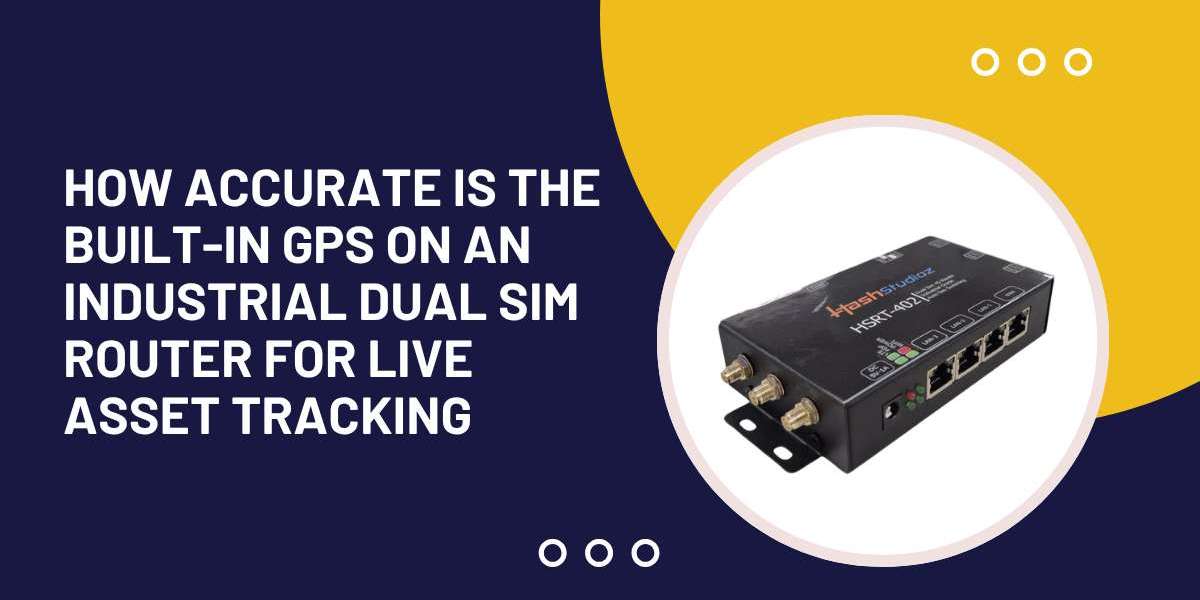

Live asset tracking keeps modern industrial operations secure, compliant, and efficient. Companies must track fleet vehicles, heavy machinery, cargo containers, and remote equipment in real time. An Industrial Router frequently serves as the central communication hub for these valuable assets.
Many modern units feature built-in GPS capabilities, but field engineers often wonder: how precise are these internal tracking modules in real-world conditions?
While a Dual SIM Industrial Router offers cellular redundancy and network stability, continuous uptime does not automatically guarantee precise location data. This technical analysis explores the accuracy, hardware architecture, and environmental factors influencing built-in GPS performance for live asset tracking.
Technical Specifications of Built-In GPS Modules
Industrial networking devices do not use standard consumer-grade GPS chips. Instead, they utilize advanced Global Navigation Satellite System (GNSS) receivers engineered for industrial environments.
1. Multi-Constellation Support
Modern industrial tracking modules track multiple satellite networks simultaneously rather than relying on a single system:
GPS: United States navigation system.
GLONASS: Russian satellite network.
Galileo: European Union system.
BeiDou: Chinese navigation network.
By processing multiple networks, the receiver views more satellites at once. A standard cellular router can track 16 to 30 satellites simultaneously. This multi-constellation approach prevents signal dropouts in challenging terrain.
2. Horizontal Position Accuracy Statistics
Under ideal conditions, a quality industrial cellular router delivers high horizontal precision:
Autonomous Mode Accuracy: 2.0 meters to 2.5 meters Circular Error Probable (CEP).
SBAS Corrected Accuracy: 0.7 meters to 1.2 meters Root Mean Square (RMS).
These statistics mean that 50% to 68% of the recorded points lie within a two-meter radius of the current location. This precision level satisfies most industrial asset tracking needs.
Key Factors That Influence Location Accuracy
Real-world deployments rarely present ideal conditions. Several physical and technical variables can degrade the precision of an internal GPS module.
1. Satellite Geometry and Dilution of Precision
The spatial distribution of satellites in the sky alters data quality. Receivers calculate positions using the intersection of satellite signals.
Ideal Geometry: Satellites spread widely across the horizon. This layout yields a low Position Dilution of Precision (PDOP) value of 1.0.
Poor Geometry: Satellites clustered closely together. This layout increases the PDOP value to 4.0 or higher, which widens the error margin.
2. Signal Strength and Receiver Sensitivity
Satellite signals travel thousands of miles to reach the Earth. By the time they arrive, the signals are incredibly weak.
Open Sky Signal Strength: -125 dBm to -130 dBm.
Obstructed Signal Strength: -150 dBm to -155 dBm.
High-sensitivity industrial modules continue tracking positions down to -165 dBm. However, weak signals naturally increase calculation errors.
3. The Multipath Effect
Urban environments create physical barriers for radio signals. Glass skyscrapers, concrete walls, and large metal structures reflect satellite signals.
Technical Insight: When a signal reflects off a building before hitting the router antenna, it travels a longer path. This delay causes the router to calculate an incorrect distance, shifting the reported asset location by 10 to 50 meters.
Cellular Redundancy and Positioning Synergy
An industrial router provides deep integration between cellular components and positioning chips. This synergy directly aids tracking performance.
1. The Role of Dual SIM Slots
A Dual SIM Industrial Router maintains continuous network connections by switching carriers during outages. If Carrier A loses coverage in a remote valley, the router moves to Carrier B within seconds. This network switch ensures the router sends location updates to the tracking server without interruption.
2. Assisted GPS (A-GPS) Performance
Cellular connections improve positioning speed. A cold-start GPS fix takes 27 to 30 seconds because the device must download satellite orbital data from space.
An Industrial Router uses its cellular link to download this data instantly from terrestrial servers. This mechanism drops the Time-to-First-Fix (TTFF) down to less than two seconds.
Hardware Architecture Enhancements
Industrial-grade routers outperform consumer mobile devices due to specialized hardware design. These physical components protect signal integrity.
1. Active vs. Passive Antennas
Most industrial setups utilize external active antennas. These units feature a built-in Low Noise Amplifier (LNA). The LNA boosts the incoming satellite signal before sending it down the coaxial cable to the router chassis. This architecture counteracts signal loss caused by long cable runs.
2. Power Supply and Electrical Protection
Industrial environments introduce electrical noise and voltage fluctuations. Heavy machinery spikes power lines.
Wide Voltage Inputs: Devices accept 9V to 36V DC inputs to handle vehicle cranking spikes.
Galvanic Isolation: Internal power filters protect GNSS RF circuits from electromagnetic interference (EMI). Clean power reduces circuit noise, which helps the receiver process weak satellite signals accurately.
Real-World Industrial Tracking Comparison
To evaluate built-in GPS accuracy, we must inspect real deployments across different industries.
1. Fleet Logistics and Transportation
Such as a long-haul freight truck carrying high-value electronics across open interstate highways, built-in GPS systems typically perform with high precision due to clear sky visibility. In these conditions, the observed accuracy generally ranges between 1.5 meters and 2.5 meters. This level of accuracy allows dispatchers and fleet managers to closely monitor vehicle movement, including determining exactly which lane a truck is traveling in or identifying the specific exit ramp it takes. Such precision enhances route verification, improves delivery tracking, and supports better operational efficiency and security for valuable cargo. Open-Pit Mining Operations
2. Pen-Pit Mining Operations:
In open-pit mining environments, where excavators and haul trucks operate deep within large earth cuts, GPS accuracy is moderately affected due to partially obstructed satellite views caused by surrounding rock walls. In these conditions, observed positioning accuracy typically ranges from 3.0 meters to 6.0 meters. Despite these challenges, modern tracking systems maintain reliable performance by combining multiple satellite constellations such as GPS and GLONASS. This multi-constellation approach helps compensate for the loss of low-horizon satellite signals blocked by the terrain, ensuring continuous tracking of heavy machinery for safety, productivity, and operational coordination.
3. Dense Urban Construction Yards:
In dense urban construction environments, such as monitoring tower cranes, generators, and heavy equipment within downtown high-rise areas, GPS performance is significantly impacted by severe multipath interference. Signals often reflect off tall buildings, creating distortions that reduce positional accuracy, which typically ranges from 5.0 meters to 15.0 meters. Although this level of accuracy is lower compared to open environments, the system remains effective for practical applications. It reliably confirms whether equipment stays within designated fenced job site boundaries, supporting compliance, safety management, and asset monitoring even in highly reflective and signal-challenged urban landscapes.
Integrated Routers vs. Dedicated Trackers
Industrial operators often debate choosing integrated routers versus dedicated battery-powered tracking tags.
Feature Component | Integrated Industrial Router | Dedicated Battery Tracking Tag |
Power Source | Permanent vehicle/mains power | Internal lithium battery |
Data Ping Frequency | Continuous per-second updates | Interval-based to save battery |
Antenna Type | High-gain external active antenna | Small internal patch antenna |
Average Accuracy | 1.0 to 2.5 meters | 3.0 to 10.0 meters |
Network Resilience | Dual SIM cellular failover | Single SIM or narrowband connection |
An Industrial Router delivers superior accuracy and higher ping frequencies because it has a continuous power source and uses external high-gain antennas.
Best Practices to Enhance GPS Precision
Engineers can implement specific hardware and software configurations to maximize router tracking accuracy.
1. Optimal Antenna Placement
Antenna location dictates tracking success. Field technicians should follow strict placement guidelines:
Line of Sight: Mount the magnetic or screw-mount antenna on the highest point of the asset.
Ground Plane: Place the antenna on a flat metal surface of at least 10 centimeters by 10 centimeters to reflect stray ground signals.
Isolation: Separate the GNSS antenna from cellular and Wi-Fi antennas by at least 50 centimeters to prevent radio frequency desensitization.
2. Advanced Software Filtering
Industrial operating systems allow users to filter out bad location data before it uploads to servers:
PDOP Masking: Configure the router to reject location fixes with a PDOP value higher than 5.0.
Speed Filtering: Ignore sudden position jumps that exceed the physical speed capabilities of the tracked asset.
Conclusion
The built-in GPS on an Industrial Router provides highly reliable location data for asset tracking. It delivers two-meter accuracy under clear skies by using multi-constellation GNSS receivers. Physical barriers and electronic noise can degrade this precision in complex environments, but proper installation mitigates these issues. Combining stable GPS chips with cellular redundancy makes a Dual SIM Industrial Router an excellent core component for tracking valuable industrial assets.