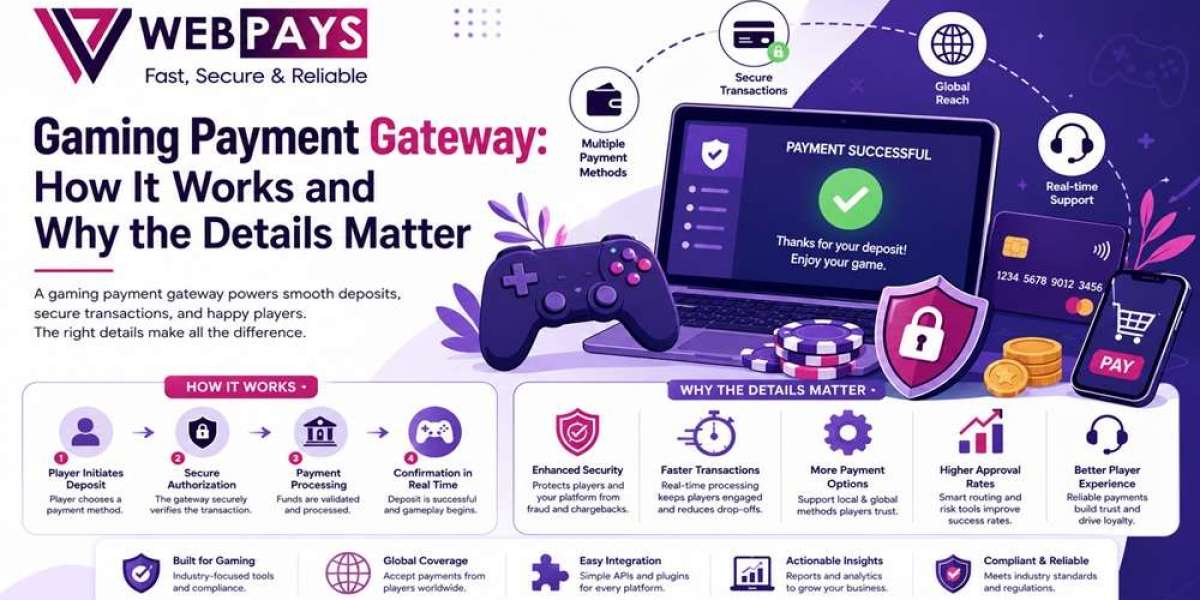

A gaming payment gateway sits between your platform and the banking network, authorising deposits, routing payouts, and screening transactions for fraud in real time — built specifically to handle the volume, chargeback rate, and compliance load that gaming businesses carry. it's paired with a high-risk merchant account and stronger fraud controls from the start.
Ask ten gaming operators how their payment gateway works and most will describe the checkout page. That's the visible 5%. The other 95% — underwriting, settlement routing, dispute handling, compliance monitoring — is what actually determines whether your platform keeps running six months from now.
The Mechanics: What Happens When a Player Pays
When a player clicks "deposit," several things happen in sequence, usually within two to three seconds:
The gateway captures the payment details and tokenises them, so raw card data never touches your servers.
Fraud screening runs — device fingerprinting, velocity checks, IP and geolocation review — before the transaction is even sent to the bank.
The transaction is routed to an acquiring bank that holds your merchant account, which authorises or declines it.
Funds settle into a rolling account, often with a reserve percentage held back for a set period.
On withdrawal, the same gateway processes the payout, again screened against fraud and AML rules before release.
Every one of these steps is more heavily scrutinised for gaming than for, say, an online clothing store, because the fraud patterns are different — bonus abuse, collusion between accounts, and rapid deposit-withdraw cycles are common in gaming and rare elsewhere.
Why Gaming Sits in Its Own Risk Category
Acquiring banks classify merchants by risk tier largely based on chargeback ratio and industry history. Gaming consistently sits in the higher tiers alongside forex, IPTV, nutraceuticals, and subscription services — not necessarily because any single operator is doing something wrong, but because the category as a whole produces more disputes and higher fraud exposure than average retail.
That classification isn't a judgment on your business. It's a statistical bucket, and it determines which banks will even consider your application, what reserve terms they'll set, and how quickly they'll react if your metrics move.
What Separates a Good Gaming Gateway from an Adequate One
Plenty of providers will say yes to a gaming merchant. Fewer will still be processing your transactions cleanly a year later. The practical differences tend to show up in:
Approval stability — whether your account survives a normal spike in volume, or gets flagged and frozen.
Reserve terms — some providers hold 10%, others hold 20% for six months; this materially affects your cash flow.
Payment method breadth — cards alone won't cut it in most Asian markets, where bank transfers and e-wallets often make up the majority of deposits.
Dispute resolution support — whether you get a dashboard and templates for representment, or you're left to fight chargebacks alone.
Multi-currency settlement — whether international players can pay in their home currency, or you're forced into single-currency processing that erodes margins on FX.
Singapore Context: Regulation Shapes the Gateway You Can Use
Any gateway operating in or through Singapore answers to the Monetary Authority of Singapore's Payment Services Act, which governs licensed payment institutions. That licensing requirement is why some international gateways simply can't route Singapore-linked settlement at all, and why local expertise matters when you're choosing a provider.
Separately, Singapore's gambling law is genuinely restrictive: the Gambling Control Act 2022 permits only Singapore Pools and the Singapore Turf Club to offer remote gambling to residents, and the Gambling Regulatory Authority — working with the Singapore Police Force since January 2025 — actively blocks unlicensed sites and disrupts related payment flows. A properly built gaming payment gateway bakes this into its compliance layer, screening merchant activity so that licensed international operators can process normally while unlawful Singapore-facing gambling traffic is refused outright. This protects both the gateway's banking relationships and the merchants using it in good faith.
Questions to Ask Before You Sign
Before committing to a gaming payment gateway provider, it's worth asking directly:
What is your rolling reserve percentage, and for how long is it held?
Which local payment methods do you support beyond cards?
What happens to my account if chargeback ratio crosses your internal threshold?
Do you hold the licensing needed to process for Singapore-linked settlement?
How is fraud scoring tuned specifically for gaming, versus generic e-commerce?
A provider that answers these clearly and specifically — rather than in marketing language — is usually the one worth trusting with your transaction volume.
Integration Realities Most Vendors Gloss Over
The technical side of adopting a gaming payment gateway is usually simpler than the compliance side, but it's not trivial. Most providers offer a REST API alongside a hosted checkout option, and gaming platforms typically prefer the API route because it keeps the player experience inside their own interface rather than redirecting to an external page. That said, a hosted or embedded checkout can still make sense for smaller operators who want PCI DSS scope handled almost entirely by the gateway provider rather than their own development team. Webhooks matter more in gaming than in most verticals, because payout status, dispute openings, and fraud flags all need to reach your platform in real time rather than through periodic polling. Before committing, ask for sandbox access and actually test a full deposit-to-payout cycle, including a simulated dispute, rather than relying on documentation alone.
Where Webpays Fits
Webpays structures its gaming payment gateway around the operational realities above rather than around a quick sign-up form. That includes a High Risk Merchant Account built for gaming from underwriting through to settlement, a Secure Payment Gateway with layered fraud and 3D Secure protection, Multi-Currency Payment Gateway support for international player bases, and broader Global Payment Solutions for operators expanding across Southeast Asia and beyond. Where currency exposure is part of the business model, Forex Merchant Account and Forex Payment Gateway options are available alongside the core gaming setup.
Frequently Asked Questions
Q: Is a gaming payment gateway the same as a merchant account?
No. A merchant account is the underlying agreement with an acquiring bank that lets you accept card payments; the payment gateway is the technology layer that processes, screens, and routes those transactions. Gaming providers typically bundle both together.
Q: Why do gaming payment gateways hold a rolling reserve?
Because gaming has a higher chargeback and refund rate than typical retail, acquiring banks require a reserve as a buffer against future disputes. The percentage and duration vary by provider and by your processing history.
Q: Can I use one gateway for both card payments and local e-wallets?
Most established gaming gateway providers support both through a single integration, which is generally more efficient than stitching together separate providers for cards versus e-wallets or bank transfers.
Q: How does a gateway know the difference between legal and illegal gambling traffic in Singapore?
Compliant gateways apply merchant licensing checks and geo-compliance rules that flag or block transactions tied to unlicensed remote gambling targeting Singapore residents, while processing normally for licensed international operators.
Q: Should I test a gaming payment gateway before going live?
Yes. A full sandbox test of the deposit-to-payout cycle, including a simulated dispute, reveals integration gaps and response-time issues that documentation alone won't show.