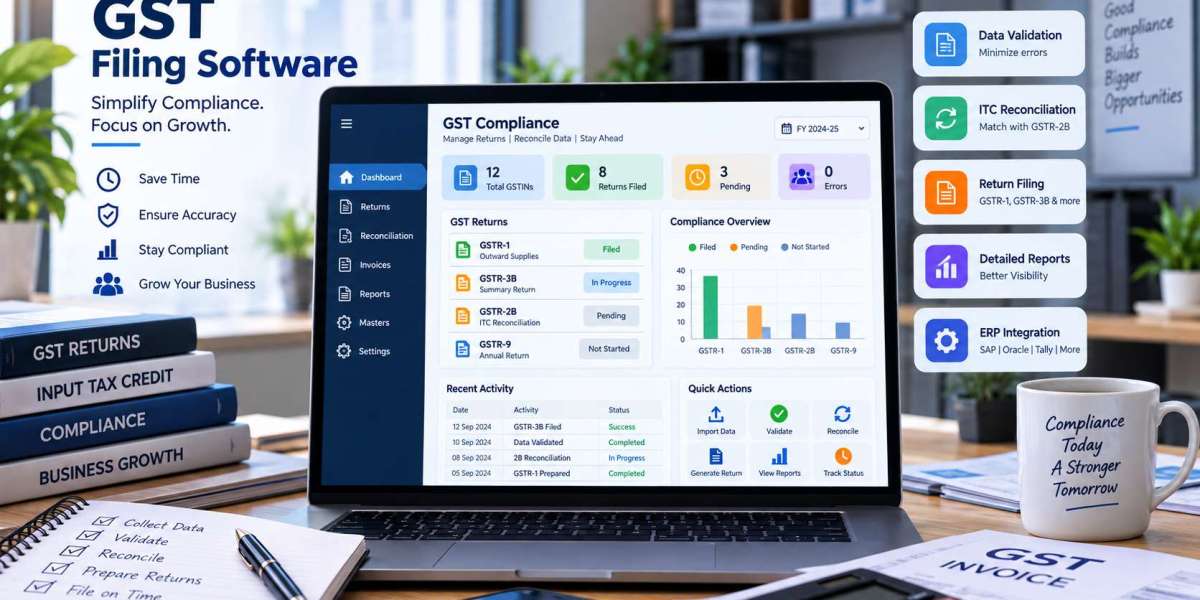

GST compliance involves more than entering figures into a return form. Businesses have to maintain transaction records, classify supplies, review tax information, reconcile purchase data, and submit the applicable returns within the prescribed process. GST filling software can bring many of these activities into a structured digital workflow.
The GST Portal itself provides online and offline methods for preparing returns. For GSTR-1, taxpayers can enter information online, upload data through the offline tool, or use third-party applications through the GST ecosystem.
The value of software therefore depends on what happens before the final filing stage. Data quality, reconciliation, validation, and reporting can all affect the overall GST workflow.
What GST Filing Software Actually Does
GST software generally acts as a layer between a company's accounting records and its GST compliance activities.
Instead of manually preparing every return from separate spreadsheets and accounting records, businesses can use software to organise transaction information and prepare relevant GST data.
Depending on the solution, the workflow may include:
Importing sales and purchase information
Validating GST-related data
Preparing return information
Reconciling purchase records
Reviewing input tax credit data
Generating compliance reports
Tracking return status
The exact functionality varies between software providers, so businesses should evaluate features according to their transaction volume and existing accounting systems.
Why Data Preparation Matters Before Filing
A GST return is only as reliable as the information used to prepare it.
For example, GSTR-1 contains details of outward supplies, including invoice-level information for registered recipients, specified inter-state supplies to unregistered persons, credit and debit notes, exports, advances, amendments, and HSN/SAC-wise summaries.
Entering or importing this information without adequate validation can create avoidable discrepancies.
A structured software workflow can provide checks before the information reaches the filing stage. This allows finance teams to identify incomplete records, inconsistent information, or other exceptions before reviewing the final return.
Reconciliation Is a Separate Part of GST Compliance
Return preparation and reconciliation should not be treated as the same activity.
Reconciliation involves comparing records from different sources and identifying differences that need investigation. This is particularly relevant when businesses review purchase information and input tax credit.
For example, Webtel's GST software describes reconciliation between purchase registers and GSTR-2A/2B, along with other comparisons involving GSTR-1, e-way bills, e-invoices, and GSTR-3B.
A reconciliation workflow can help a business identify mismatches before finalising its GST information.
The software does not eliminate the need for professional review. Instead, it can make exceptions easier to identify and investigate.
GSTR-1 and GSTR-3B in the Filing Workflow
Two important GST return forms frequently encountered by regular taxpayers are GSTR-1 and GSTR-3B, although applicability depends on the taxpayer and relevant GST provisions.
GSTR-1 is the statement of outward supplies. The GST Portal provides facilities for preparing it online or through an offline upload. After entering or importing the information, taxpayers can generate a summary, review the consolidated information, and proceed with filing.
GSTR-3B is a summary return used to declare relevant tax liabilities and other information for the applicable tax period. The GST Portal provides a separate workflow for preparing and filing the form.
Software can help organise the data feeding these processes, but businesses still need to review the information and follow the applicable filing requirements.
Where ERP Integration Becomes Useful
Businesses that already use ERP or accounting systems may have large volumes of transaction data. Copying information manually into another application can create unnecessary work and additional opportunities for data-entry errors.
An integrated approach can allow relevant information to move from an existing ERP or accounting environment into the GST workflow.
Webtel's ERP-integrated GST solution states that it supports data imports from systems including SAP, Oracle, Microsoft Dynamics, Tally, Busy, Excel, and other ERP solutions. The solution also describes return generation, data validation, reconciliation, and filing within the same workflow.
Businesses considering an integrated approach can review the available ERP-integrated GST filing software to understand how ERP data can be connected with GST compliance activities.
The main consideration should be compatibility with the accounting environment already being used.
Features Worth Checking Before Choosing GST Software
Not every GST application provides the same level of functionality. A business should evaluate software based on its actual compliance workflow.
Data import
Check whether the software can import information from the accounting or ERP systems already used by the organisation.
Validation
Look for checks that can identify incomplete or inconsistent records before return preparation.
Reconciliation
Review whether the application can compare purchase records with relevant GST information and identify exceptions.
Return preparation
Check which GST returns and forms the software supports and whether the workflow matches the organisation's filing requirements.
Reporting
Reports can help finance teams review sales, purchases, tax amounts, reconciliation results, and filing status.
Security
GST data contains sensitive financial and business information. Businesses should review the software's security architecture, access controls, deployment model, and applicable security certifications.
How Automation Changes the Filing Process
Automation is useful when it removes repetitive manual steps without removing necessary review.
A typical workflow might look like this:
Accounting or ERP data → Data validation → GST return preparation → Reconciliation → Review → Filing → Status tracking
This structure makes it easier to identify where an issue occurred.
For example, if a mismatch appears during reconciliation, the finance team can investigate the underlying transaction rather than discovering the issue only after completing the return.
Webtel's GST software describes automated return filing, GSTR-2A/2B reconciliation, data validation, color-coded data segregation, and return-status tracking as part of its feature set.
Common Mistakes to Avoid
Technology does not automatically make a GST process accurate. Poor source data can still create problems.
One common mistake is importing records without reviewing the underlying master data. Incorrect GSTINs, missing tax information, or inconsistent customer and vendor records can affect downstream compliance work.
Another issue is treating reconciliation as an optional final check. Differences between accounting records and GST data may require investigation before the relevant return is finalised.
Businesses should also avoid assuming that every return can be handled using the same workflow. GST requirements vary according to taxpayer type, registration status, filing frequency, and the nature of transactions.
The GST Portal's official guidance should therefore be used when confirming current filing requirements and procedures.
What Makes a GST Workflow Scalable?
A GST process becomes harder to manage as transaction volume, locations, registrations, and reporting requirements increase.
A scalable workflow should make it possible to:
Process larger transaction datasets
Maintain consistent validation rules
Reconcile records systematically
Monitor filing status
Generate reports for review
Integrate with existing business systems
For organisations with multiple registrations or ERP environments, integration can be particularly relevant because the same underlying financial data may need to support several compliance activities.
Webtel describes its ERP-integrated GST solution as supporting multiple ERP environments and GST return workflows including GSTR-1, GSTR-3B, GSTR-9 and GSTR-9C.
Frequently Asked Questions
What is GST filing software?
GST filing software is a digital application used to organise GST-related data and support activities such as return preparation, validation, reconciliation, reporting, and filing.
Can GST software integrate with accounting systems?
Some GST solutions can integrate with accounting and ERP systems. Webtel states that its ERP-integrated solution supports data import from systems such as SAP, Oracle, Microsoft Dynamics, Tally, Busy, and Excel.
Does GST software replace the GST Portal?
Software can support return preparation and filing workflows, but taxpayers still operate within the applicable GST filing framework. The GST Portal itself provides online and offline methods for preparing and filing returns.
How does GST software help with ITC reconciliation?
GST software can compare purchase records with available GST information and highlight differences for review. This can help finance teams investigate discrepancies before finalising relevant GST information.
Conclusion
GST compliance involves several connected activities, from maintaining transaction data to preparing returns and reviewing reconciliations. GST filing software can bring these activities into a more structured workflow and reduce repetitive manual work.
The right solution depends on the organisation's transaction volume, accounting systems, number of GST registrations, reconciliation requirements, and internal review process.
For businesses looking to combine return preparation with reconciliation and data validation, GST filling software can be evaluated as part of a broader digital GST compliance workflow.