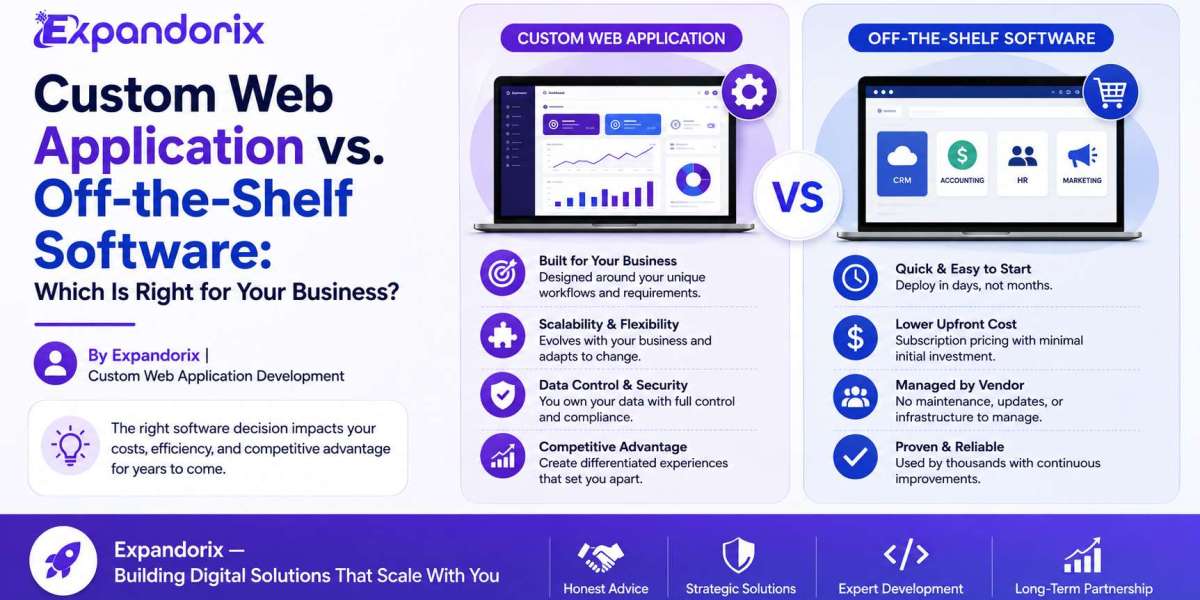

It is one of the most common questions we hear from business owners and technology leaders: "Should we build a custom solution or buy an existing one?" It sounds like a simple question, but the honest answer is: it depends. And getting the decision right matters enormously — not just for your technology budget, but for your operational efficiency, your team's productivity, and your competitive positioning for years to come.
At Expandorix, we develop custom web applications. But we are not in the business of telling every client they need custom development regardless of the facts. Our job is to help you make the right decision for your situation — and sometimes that decision is a hybrid approach. This blog will give you a clear, honest framework for evaluating your options.
Understanding the Two Ends of the Spectrum
Before comparing options, it helps to define what we are actually comparing.
Off-the-shelf software (also called commercial off-the-shelf, or COTS) refers to ready-made applications that you purchase or subscribe to as-is. Examples include Salesforce for CRM, QuickBooks for accounting, Shopify for e-commerce, and HubSpot for marketing automation. These products are built for a broad market and are designed to work for as many users as possible out of the box.
Custom web application development refers to software built from scratch (or from curated frameworks) specifically for your business. It is designed around your exact workflows, your specific integrations, and your particular user needs. No other business uses the exact same tool in the exact same way.
Between these two poles sit configurable SaaS platforms (highly customizable off-the-shelf tools) and low-code/no-code platforms (tools that allow non-developers to assemble applications from prebuilt components). These middle-ground options deserve consideration too.
When Off-the-Shelf Software Wins
Let us be direct: off-the-shelf software is the right choice in many situations. Here is when it makes the most sense.
You are solving a well-understood, common problem. If you need accounting software, email marketing, or basic HR management, the problem is well-defined and dozens of mature products have already solved it elegantly. Building your own accounting platform is almost never worth it.
You are early stage and need to move fast. Startups and early-stage businesses often need to validate ideas and acquire customers before they can justify the cost and time of custom development. A $50/month SaaS tool that gets you to market in a week is often the right call over a six-month development project.
Your team does not have the technical capacity to maintain custom software. Custom applications require ongoing maintenance — dependency updates, security patches, performance optimizations. If you don't have developers on staff or a trusted development partner, a managed SaaS product may be more reliable in practice.
The vendor's roadmap aligns with your needs. If a software vendor's product is evolving in the direction your business needs to go, riding that roadmap can be very cost-effective. You benefit from R&D you didn't have to pay for.
When Custom Web Application Development Wins
Custom development is the right choice when your situation has moved beyond what off-the-shelf software can accommodate.
Your workflows are genuinely unique. Most businesses have at least some processes that differentiate them from competitors. When those differentiated processes are central to your operations, forcing them into a generic tool creates friction, workarounds, and errors. A custom application mirrors your actual workflow rather than forcing you to mirror the software's workflow.
You are paying for features you don't use. Many SaaS products charge for a bundle of features, a significant portion of which may be irrelevant to your business. Custom development means you pay only to build what you actually need.
You need deep integrations across multiple systems. If your business requires tight, real-time integration between multiple platforms — ERP, CRM, supply chain, customer portal, IoT data — off-the-shelf solutions often struggle to provide the depth and reliability of integration you need. Custom applications can be engineered around your integration requirements from the ground up.
Data privacy or compliance is paramount. For businesses in healthcare, finance, legal services, or government, data residency requirements, audit trails, and compliance features may be impossible to achieve with a third-party SaaS platform. A custom application gives you full control over where data lives and how it is handled.
You are at the scale where SaaS costs are significant. As mentioned, per-user SaaS pricing can compound dramatically. Once your headcount or transaction volume reaches a certain threshold, the economics of custom development become increasingly favorable.
You want competitive differentiation from your software. If your technology is a source of competitive advantage — faster workflows, better customer experiences, proprietary analytical models — you cannot achieve that with the same tools your competitors are using.
The Total Cost of Ownership Analysis
One of the most important shifts in thinking required when evaluating this decision is moving from "upfront cost" to "total cost of ownership" (TCO) over a three-to-five year horizon.
Off-the-shelf software looks cheap upfront. A $200/month subscription feels like nothing. But at $200/month, over five years, you have paid $12,000 — and for many enterprise tools, the real cost is $2,000–$5,000 per user per year. At 50 users, that is $100,000–$250,000 per year, or $500,000–$1.25 million over five years.
A custom application might cost $100,000–$200,000 to build, with $15,000–$30,000 per year in maintenance and enhancements. The five-year TCO might be $175,000–$350,000 — significantly less than the SaaS alternative at that scale, and you own the asset at the end.
This analysis will be different for every business, and we always recommend running the numbers for your specific situation. But the reflex that "SaaS is cheaper" does not hold at scale.
The Hybrid Approach
In practice, many of the best technology strategies combine both custom and off-the-shelf elements. You might use Salesforce as your CRM (a well-supported industry standard) while building a custom customer portal that integrates with it (because your client onboarding process is unique). You might use QuickBooks for accounting while building a custom operations management platform for your field teams.
At Expandorix, we frequently design architectures that connect custom applications to best-in-class SaaS tools via APIs. You get the reliability of established platforms in commodity areas and the precision of custom software where it matters most.
Questions to Ask Before Deciding
To help you evaluate your own situation, here are the key questions we walk through with prospective clients:
- Is the core problem you are solving well-understood and commonly faced by businesses in your industry, or is it specific to your operations?
- What is the three-year cost of your current SaaS tools, and how does that compare to estimated development costs?
- Do you have the data privacy or compliance requirements that limit your SaaS options?
- How many manual processes or workarounds have you built because your software doesn't fit your workflow?
- Do you have ongoing technical support available to maintain a custom application?
If your answers reveal significant limitations in your current tools, high costs at scale, compliance requirements, or a unique workflow that generic software cannot support, custom development is worth a serious evaluation.
Conclusion
There is no universal right answer to the build-vs-buy question. The best decision is the one that aligns with your operational needs, your growth trajectory, your budget, and your technical capacity. What Expandorix offers is an honest evaluation of your situation — and if custom development is the right path, world-class execution to make it a reality.
Ready to explore your options? Schedule a free consultation with the Expandorix team today.
Expandorix — Building Digital Solutions That Scale With You