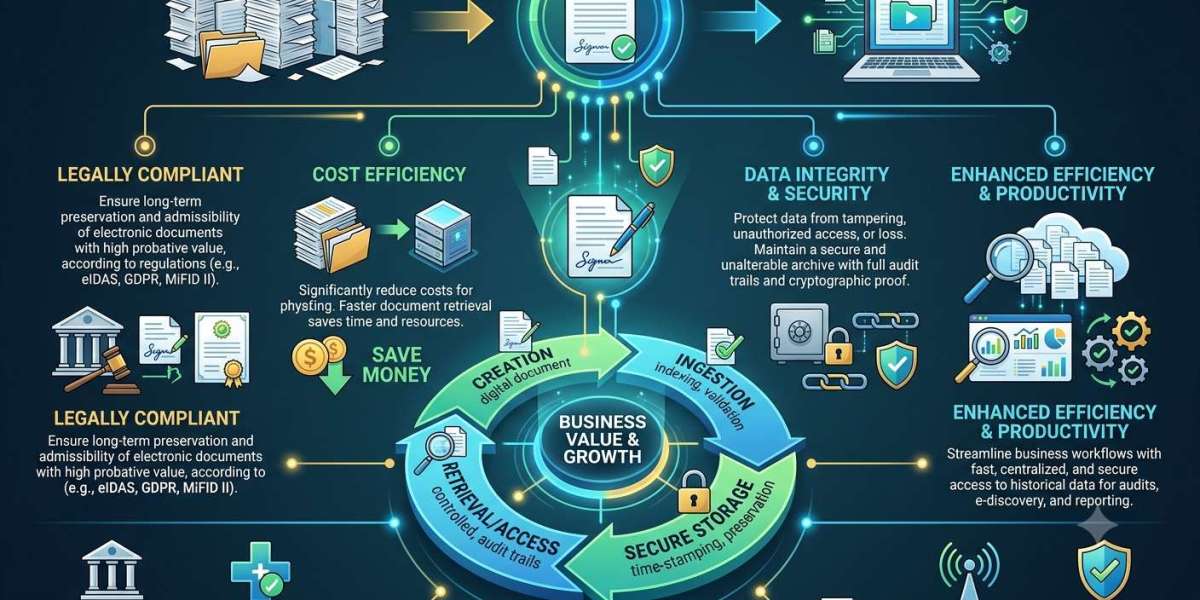

Businesses in regulated industries generate a massive volume of critical documents, from financial records and contracts to compliance reports, medical files, and legal documents. Qualified Electronic Archiving provides a secure, legally compliant, and structured way to store these records, ensuring businesses can meet regulatory requirements while improving operational efficiency. For industries like finance, healthcare, insurance, pharmaceuticals, and government, improper record handling can lead to fines, legal disputes, and reputational damage.
1. Ensures Compliance With Industry Regulations
Regulated industries operate under strict rules about how long and in what format records must be kept. Qualified electronic archiving ensures that documents are stored according to the exact specifications required by regulatory bodies. This includes retention periods, audit trails, secure storage, and tamper-evident systems.
For example, in the financial sector, regulators require firms to preserve client transaction records for multiple years. Non-compliance can result in fines or legal penalties. Similarly, healthcare organizations must protect patient data while retaining medical records for mandated durations. By using qualified electronic archiving, businesses can automatically meet these requirements, reducing the risk of human error or oversight.
2. Protects Records From Alteration or Loss
One of the main challenges in managing records is ensuring their integrity over time. Qualified electronic archiving solutions provide tamper-proof storage and version control. This ensures that once a document is archived, its content cannot be altered without leaving a trace.
This level of protection is crucial in audits, litigation, and compliance reviews. Businesses can demonstrate the authenticity of records, proving that the information has not been modified since archiving. According to AIIM research, companies that implement certified electronic archiving systems reduce risks of document loss and non-compliance by up to 40%.
3. Improves Operational Efficiency
Qualified electronic archiving does more than protect documents it also improves access and efficiency across teams. When records are stored in a structured, searchable system, employees can quickly find the information they need for audits, client requests, legal reviews, or internal reporting.
For instance, finance teams can retrieve historical transaction records in minutes instead of hours. Compliance teams can generate reports quickly, ensuring faster regulatory submissions. HR teams can locate historical employee documents efficiently. By reducing time spent searching for records, businesses save costs and improve productivity.
4. Reduces Legal and Financial Risks
Improperly stored or unorganized records in regulated industries can lead to severe consequences. Missing or incomplete documentation may trigger regulatory investigations, lawsuits, or financial penalties.
Qualified electronic archiving mitigates these risks by ensuring records are complete, authentic, and traceable. This is particularly valuable for industries where even minor record-keeping errors can result in significant fines, such as banking or pharmaceuticals. By maintaining proper archives, businesses strengthen their legal position and protect their reputation.
5. Supports Audit Readiness and Transparency
Auditors often require access to historical records, approvals, and process documentation. Qualified electronic archiving ensures that records are not only stored securely but also remain easily accessible and verifiable.
Audit trails, access logs and metadata provided by these systems allow businesses to prove exactly when documents were archived, who accessed them, and whether any changes occurred. This transparency reduces audit preparation time and increases confidence in compliance reporting.
6. Facilitates Digital Transformation
In addition to compliance and risk management, qualified electronic archiving supports broader digital transformation initiatives. By converting paper-based or legacy systems into certified digital archives, organizations streamline workflows, integrate with enterprise systems, and enable advanced data analytics.
For example, pharmaceutical companies can link archived clinical trial data with analytics platforms to gain insights while maintaining compliance with FDA or EMA regulations. Similarly, banks can combine archived transaction data with reporting systems to enhance risk management and reporting accuracy.
7. Strengthens Business Continuity
Disasters, system failures, or employee turnover can jeopardize access to critical records. Qualified electronic archiving ensures that documents remain available even during disruptions. Cloud-based or hybrid certified archiving systems provide secure backups and redundancy, ensuring that vital business information can be accessed anytime, anywhere.
This reliability helps companies maintain uninterrupted operations and reduces the potential impact of emergencies on regulatory reporting or operational decision-making.
Conclusion
For regulated industries, proper record management is not optional. Qualified Electronic Archiving delivers measurable business value by ensuring compliance, protecting document integrity, improving operational efficiency, and mitigating legal and financial risks.
By investing in certified archiving solutions, businesses can streamline access to critical records, maintain audit readiness, support digital transformation, and strengthen business continuity. In sectors where compliance and data integrity are essential, qualified electronic archiving is not just a technical solution it is a strategic business asset.