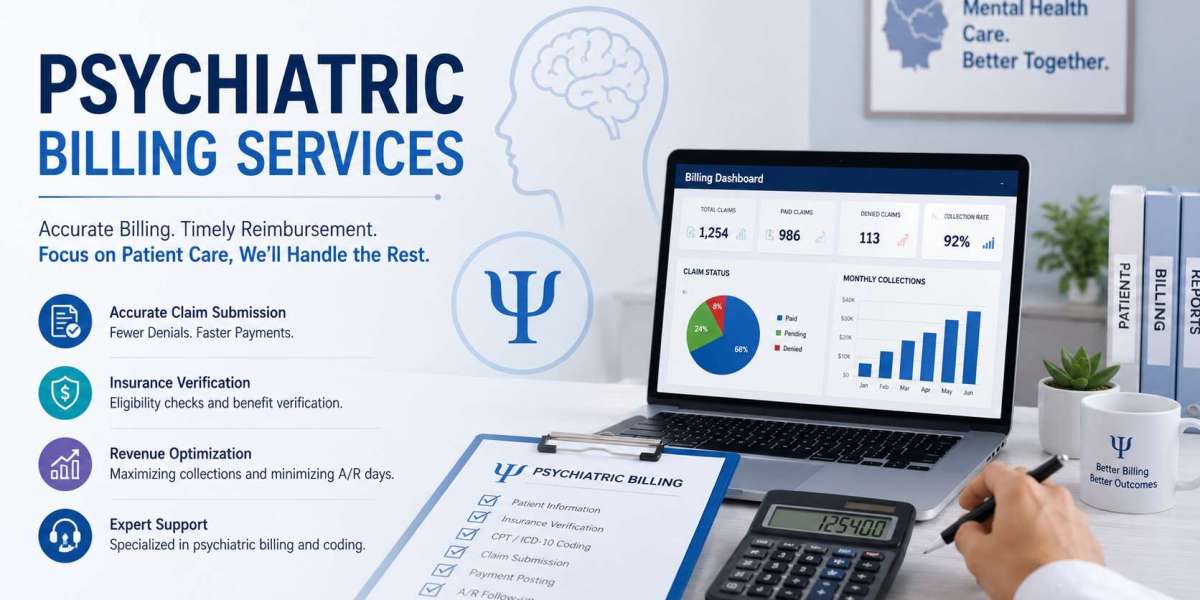

Introduction
Healthcare practices that deal with mental and behavioral health face unique administrative and financial challenges. Unlike general medical specialties, psychiatric care involves longer consultations, therapy sessions, medication management, and complex treatment plans that require precise documentation and coding. This is where psychiatric billing and coding services play a crucial role in ensuring smooth revenue flow and compliance with insurance requirements.
Accurate billing in psychiatry is not just about submitting claims; it is about understanding behavioral health CPT codes, modifiers, session time tracking, and payer-specific rules. Even a small mistake can lead to claim denials, delayed reimbursements, or revenue loss. As mental health services continue to grow globally, the demand for specialized billing expertise has also increased significantly.
In this blog, we will explore how psychiatric billing works, common challenges, benefits of outsourcing, and best practices to improve reimbursement efficiency for behavioral health providers.
Understanding Psychiatric Billing and Coding Services
Psychiatric billing and coding services involve the process of translating mental health services into standardized medical codes and submitting claims to insurance companies for reimbursement. These services are designed specifically for behavioral health providers such as psychiatrists, psychologists, therapists, and counseling centers.
Psychiatric billing includes several key components:
- CPT Coding (Current Procedural Terminology): Used to describe psychiatric evaluations, psychotherapy sessions, medication management, and crisis interventions.
- ICD-10 Coding: Represents mental health diagnoses such as depression, anxiety disorders, bipolar disorder, PTSD, and schizophrenia.
- Modifiers: Indicate specific circumstances like telehealth sessions, time-based billing, or combined services.
- Time-Based Billing: Many psychiatric services depend on session duration, making accurate time tracking essential.
For example, a 45-minute psychotherapy session will have a different billing code than a 30-minute medication management visit. Insurance companies require strict documentation to justify these services.
In addition, behavioral health billing must comply with payer policies, HIPAA regulations, and state-specific guidelines. This makes psychiatric billing highly specialized compared to other medical fields.
Key Challenges in Psychiatric Billing and Coding
Psychiatric practices often face several obstacles when managing billing in-house. These challenges can directly affect revenue cycle performance and operational efficiency.
1. Complex Coding Structure
Mental health billing involves multiple CPT and ICD-10 codes that change frequently. Choosing the wrong code or missing a modifier can result in claim rejection. Providers must stay updated with annual coding changes, which can be time-consuming.
2. Time-Based Documentation Errors
Most psychiatric services are time-dependent. If documentation does not clearly reflect session duration, insurers may deny the claim. Even a few minutes of discrepancy can impact reimbursement.
3. Insurance Verification Issues
Behavioral health insurance coverage varies widely. Some plans limit the number of therapy sessions, require prior authorization, or exclude certain treatments. Failure to verify eligibility can lead to unpaid claims.
4. High Claim Denial Rates
Psychiatric billing often experiences higher denial rates due to incomplete documentation, incorrect coding, or missing authorizations. Reworking denied claims adds additional administrative burden.
5. Compliance and Privacy Regulations
Psychiatric records are highly sensitive. Practices must follow strict HIPAA compliance rules while handling patient data and submitting claims, which adds another layer of responsibility.
These challenges make it essential for practices to adopt efficient systems or partner with experts in psychiatric billing and coding services.
Benefits of Outsourcing Psychiatric Billing and Coding Services
Outsourcing has become a preferred solution for many behavioral health providers who want to improve efficiency and reduce administrative workload. Here are the key benefits:
Improved Accuracy and Fewer Errors
Professional billing teams specialize in behavioral health coding. Their expertise reduces the chances of errors in CPT and ICD-10 coding, leading to faster claim approvals and fewer denials.
Faster Reimbursements
With accurate claim submissions and proper documentation, outsourced billing services help speed up reimbursement cycles. This ensures a steady cash flow for psychiatric practices.
Reduced Administrative Burden
Psychiatrists and therapists can focus more on patient care instead of spending time on billing, coding, and insurance follow-ups. This improves overall productivity and service quality.
Cost Efficiency
Maintaining an in-house billing team requires salaries, training, and software investments. Outsourcing eliminates these overhead costs while still ensuring professional billing management.
Better Compliance Management
Outsourced billing providers stay updated with changing regulations, payer policies, and coding updates. This helps practices remain compliant and avoid penalties.
Enhanced Revenue Cycle Management
From claim submission to denial management and payment posting, outsourced services optimize the entire revenue cycle, ensuring maximum revenue collection.
Best Practices for Efficient Psychiatric Billing and Coding
To achieve consistent financial performance, psychiatric practices should follow proven billing best practices:
1. Maintain Accurate Clinical Documentation
Every psychiatric session must include detailed notes such as diagnosis, treatment plan, session duration, and patient response. Clear documentation supports correct coding and reduces claim disputes.
2. Use Updated Coding Guidelines
Always use the latest CPT and ICD-10 codes. Regular updates ensure compliance and prevent outdated coding errors that lead to denials.
3. Verify Insurance Before Each Visit
Eligibility checks should be performed before patient appointments. This helps identify coverage limits, co-pays, and authorization requirements in advance.
4. Implement Technology Solutions
Using electronic health records (EHR) integrated with billing systems can reduce manual errors and streamline workflows. Automation also improves claim tracking and reporting.
5. Monitor Denials and Take Action Quickly
Denial management is a critical part of psychiatric billing. Practices should analyze denial patterns and correct issues immediately to prevent recurring errors.
6. Train Staff Regularly
Billing staff should receive continuous training on behavioral health billing updates, payer rules, and compliance requirements to maintain accuracy.
Frequently Asked Questions (FAQ)
1. What are psychiatric billing and coding services?
Psychiatric billing and coding services involve converting mental health treatments into standardized medical codes and submitting insurance claims for reimbursement.
2. Why is psychiatric billing more complex than general medical billing?
It involves time-based coding, behavioral health-specific CPT codes, strict documentation rules, and varying insurance coverage policies.
3. What are common codes used in psychiatric billing?
Common codes include psychotherapy session codes, psychiatric evaluation codes, medication management codes, and crisis intervention codes along with ICD-10 mental health diagnoses.
4. How can outsourcing help psychiatric practices?
Outsourcing improves accuracy, reduces claim denials, speeds up reimbursements, and allows healthcare providers to focus on patient care.
5. What causes claim denials in psychiatric billing?
Common reasons include incorrect coding, missing documentation, lack of authorization, and eligibility verification errors.
Conclusion
Efficient financial management is essential for every behavioral health practice, and psychiatric billing and coding services play a key role in achieving that goal. With increasing demand for mental health care, providers must ensure that their billing processes are accurate, compliant, and optimized for maximum reimbursement.
From handling complex coding structures to managing insurance requirements and reducing claim denials, specialized billing support can significantly improve revenue cycle performance. Whether a practice is small or large, investing in professional billing systems or outsourcing services can lead to better financial stability and reduced administrative stress.
Ultimately, partnering with experienced Medical Billing Services helps psychiatric practices streamline operations, improve cash flow, and focus on what truly matters—delivering quality mental health care to patients.