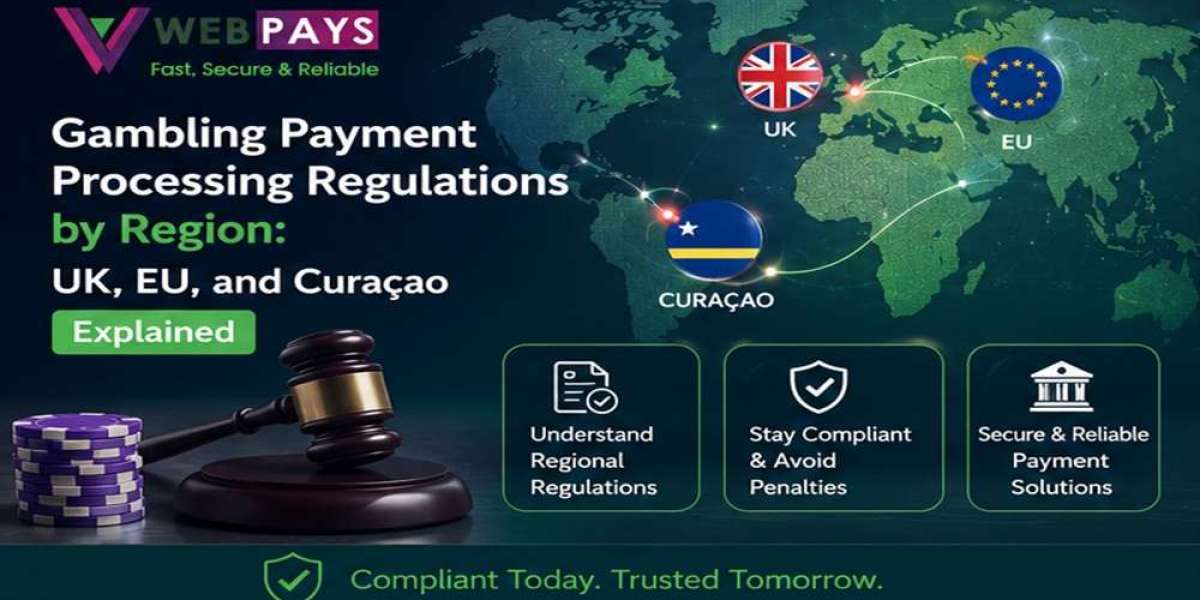

"Gambling laws vary by region" is true but not very useful on its own. What actually determines whether you can get — and keep — a payment processing relationship is which license you hold, which jurisdiction your customers are in, and how those two things line up. Here's a breakdown of the three regulatory environments gambling operators deal with most often, and what each means practically for payment processing.
Why Licensing Jurisdiction Is the First Thing Processors Check
Before a payment processor or acquiring bank will even quote pricing, they need to know your license — because the license determines their own regulatory exposure. A processor facilitating payments for an unlicensed or improperly licensed operator in a given market risks fines, forced account closures, and reputational damage with the card networks themselves. This is why "get a license" is the recurring first line of advice in this space — it's not a formality, it's the mechanism that makes payment processing possible at all.
United Kingdom: The UK Gambling Commission
The UK operates one of the most tightly regulated gambling markets globally. Any operator offering gambling services to UK-based customers needs a license from the UK Gambling Commission (UKGC), regardless of where the operator itself is based.
What this means for payment processing:
UK-facing acquirers and card networks actively screen for UKGC licensing before approving or continuing to process gambling transactions.
The UKGC has specific rules around affordability checks and problem-gambling safeguards, and processors increasingly expect operators to demonstrate these controls are in place — it affects underwriting, not just legality.
Card network rules (Visa and Mastercard both maintain gambling-specific merchant category codes) mean transaction descriptors and reporting must be accurate and specific to gambling, not disguised as another category.
European Union: A Patchwork, Not a Single Market
Unlike many financial services categories, gambling is not harmonized across the EU. There's no single "EU gambling license" — each member state regulates independently, and a license in one country generally does not authorize you to operate in another.
Key jurisdictions operators commonly target:
Malta (MGA — Malta Gaming Authority): Widely used as a base license for operators targeting multiple EU markets, though it doesn't automatically grant market access to countries with their own local licensing requirements (e.g., Germany, France, Spain, Netherlands, which all require separate local licenses).
Country-specific requirements: Germany's regulatory framework, for instance, has its own licensing body and rules distinct from Malta's, and processors will check whether you hold the specific local license needed for the customers you're actually serving — not just an EU-based license generally.
What this means for payment processing: because the EU isn't a single regulatory zone, a processor may approve you for MGA-licensed traffic but require separate verification (or decline) traffic from countries with their own local licensing regimes. Be precise with your processor about exactly which countries you serve and under which license — vague answers here are one of the most common reasons EU-facing gambling accounts get flagged during review.
Curaçao: Lower Barrier to Entry, More Processor Scrutiny
Curaçao licensing (historically issued under a master license structure, with reforms underway to move toward individual licenses issued directly by the Curaçao Gaming Authority) has long been a popular entry point for operators due to comparatively lower cost and faster issuance than UK or Malta licensing.
What this means for payment processing:
Because Curaçao licensing has historically had a reputation for lighter oversight compared to UKGC or MGA, some acquirers apply additional scrutiny, higher reserves, or outright decline Curaçao-licensed operators depending on their own risk appetite.
Curaçao's regulatory framework has been undergoing reform, with the aim of tightening licensing and compliance standards — operators should confirm current requirements directly with the Curaçao Gaming Authority, as processor expectations are shifting alongside these reforms.
Processors that do accept Curaçao-licensed merchants typically require more robust internal compliance documentation (AML procedures, source-of-funds checks, responsible gambling tooling) to offset the perceived regulatory gap versus UK or EU licensing.
The Practical Takeaway for Operators
A few principles apply across all three jurisdictions:
License for the markets you actually serve, not just where it's cheapest to license.
A processor will ask which countries your customers are in, and a mismatch between your license scope and your customer geography is one of the fastest ways to get declined or later terminated.Be ready to document compliance, not just show a license certificate.
AML policies, KYC procedures, and responsible gambling controls are increasingly part of what processors underwrite against — a license alone isn't sufficient evidence of low risk.Expect reserves and pricing to reflect your specific license, not "gambling" as a category.
UKGC-licensed operators generally get better terms than Curaçao-licensed operators processing the same volume, because the acquirer's own regulatory risk differs.Regulations are moving targets.
Curaçao's reform process and evolving EU member-state rules mean the landscape you licensed under two years ago may not be the landscape your processor is underwriting against today. Confirm current requirements before renewal conversations or when entering a new market.
Bottom Line
Payment processing access for gambling operators isn't just a function of finding a processor willing to work with "high-risk" merchants — it's a function of your specific license matching your specific customer geography, backed by real compliance documentation. Get that alignment right, and processing terms improve considerably. Get it wrong, and no amount of shopping around for a friendlier processor will fix an underlying licensing mismatch.