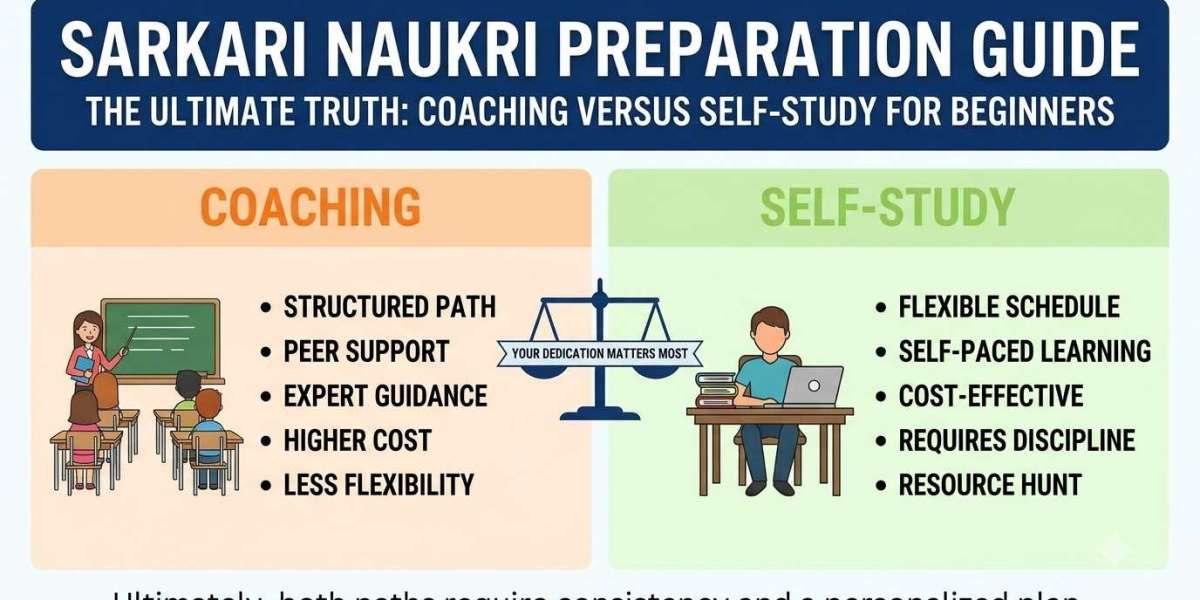

Making preparations for Sarkari Naukri can be considered one of the largest career aims of numerous Indian students. Annually, examinations like SSC, RRB, IBPS, UPSC, State PSC, Defence, and various other state government recruitment processes draw lakhs of candidates. There comes one such question that most beginners would want to ask:
Is it better for me to join any coaching classes or study on my own?
In essence, the answer is not fixed and can only vary according to personal situations. Thousands of individuals qualify themselves for various government examinations through self-preparations, whereas many take help from coaching.
Why This Decision Matters
Correct choice of approach will not only help save time but also money. Prior to opting for coaching classes, a beginner needs to consider:
Learning style
Budget
Available study time
Self-discipline
Previous academic background
Target examination
Making the right choice from the start will help keep up with consistency.
What Coaching Institutes Offer
Coaching institutes offer a systematic learning plan that helps you prepare for exams easily.
Advantages of Coaching
1. Structured Study Plan
Students are provided with a predetermined timetable of all the syllabus material in order.
2. Expert Faculty
Difficult concepts explained and shortcuts in quantitative aptitude, reasoning and English are explained by experienced teachers.
3. Regular Tests
Weekly and monthly mock tests are used to measure preparation.
4. Doubt Clearing Sessions
Students can ask questions as they go without conceptual confusion.
5. Competitive Environment
When studying with other aspirants, it is healthy competition and motivation.
Limitations of Coaching
However, despite the various advantages, coaching does not ensure selection.
Some of the typical disadvantages are:
High fees
Fixed schedules
Long travel time for offline classes
Less flexibility for working candidates
Different learning speed for every student
Even the students who attend coaching have to revise on their own later.
Why Self-Study Has Become More Popular
The existence of quality online sources has brought a change to competitive exam preparation.
Now, a candidate can easily obtain:
Official Syllabus
Previous year question paper
Youtube lecture series
Online mock test
Digital Notes
Current affair website
Mobile app
All these sources have made self-study a very effective mode of preparation for many beginners.
Advantages of Self-Study
Flexibility Schedule
One can study in accordance with his/her own timetable.
Low Cost
Except for books and practice exams, not much expense needs to be incurred.
Good Time Management
Aspirants study more often than travel.
Individual Learning
Time could be spent on poor performance subjects without adhering to classroom speed.
Strong Revision
Revision can be easily carried out as the individual is in charge of his/her own study schedule.
Challenges of Self-Study
Self-learning also entails being responsible.
The following are some issues that are common to learners:
Lack of discipline
Procrastination
Confusion about study material
No immediate doubt resolution
Difficulty tracking progress
Most learners lack motivation due to poor planning within a few months.
Coaching vs Self-Study: Quick Comparison
1. Cost
Coaching: Expensive classroom coaching, study material and test series.
Self-Study: Low cost, primarily involves books, internet resources, and sample tests.
2. Flexibility
Coaching: They are not flexible in coaching because of the fixed class schedule.
Self Study: study any time and at your own pace.
3. Daily Schedule
Coaching: A timetable prepared by the institute, which consists of phases.
Self Study: Flexible study plan according to you.
4. Guidance
Concept Explanation with Doubt Resolution: Expert faculty resolves all your conceptual queries and helps to clear the exam from our books and recorded video classes.
Self Study: Through online video lessons and study material you study on your own by booking slots that suit you.
5. Discipline
Coaching: It is easy to be disciplined due to the classes and tests conducted regularly.
Self Study: It takes a lot of discipline, motivation, and time management skills.
6. Best For
Coaching: This option is perfect for those who are new to the topic and want professional guidance.
Self-Study: People that are self-starters and are looking for in-depth information to read through will benefit from this.
Which Option Is Best for Beginners?
Go For Coaching When You:
Are preparing for the first time
Need ongoing help
Struggle with quantitative topics
Can’t manage consistency on your own
Prefer classroom study
Go For Self-Study When You:
Are disciplined
Have a low budget
Can manage a routine
Learn from books and video lectures
Know the basic concepts of the exam
Many successful students opt for self-study and just buy test series or specific topic classes.
The Hybrid Approach: Best of Both Worlds
In 2026, many toppers opt for a combined approach of preparation.
Instead of taking up costly full-time coaching, they resort to:
Standard books
Free online classes
Paid mock tests
PYQ practice
Limited mentorship
Online doubt sessions
This method saves money yet ensures guidance whenever required.
Essential Resources for Self-Study
A beginning candidate must always use the following resources:
Official examination announcement
Updated syllabus
Past year question papers
Good reference books
Monthly current affairs
Mock tests
Good daily newspaper or current affairs publication
It is always advisable to check official websites of recruitment for updates on notification and syllabus.
Common Mistakes Beginners Should Avoid
Most people who try to join fail on account of avoidable errors.
Do not develop these behaviours:
Collecting too many books
Ignoring the official syllabus
Skipping previous year papers
Not revising regularly
Giving very few mock tests
Changing preparation strategy every month
Comparing yourself with others
The best approach is one that concentrates more.
Is Coaching Necessary in 2026?
The short answer would be, No.
Although coaching can help with preparation in terms of guidance and structuring, it cannot substitute for self-study on a regular basis. Candidates who keep on revising and solving last year’s questions, analyzing their mock tests, and who are disciplined will have a high probability of clearing the Sarkari Naukri exam.
Final Thoughts
The biggest truth about Sarkari Naukri preparation is the result always depends on your sheer determination, and neither on the presence of coaching or your self-study. Coaching ensures guidance while self-study enforces discipline and the will to perform the job well and with confidence. However, beginners should make a prudent comparison about their own capabilities, shortcomings, pocket and learning approach. But ultimately, whether you are in coaching or have chosen the tough road of self-study, the same set of parameters such as revision, mock-tests, and proper strategies will remain relevant for government exam preparation in 2026.