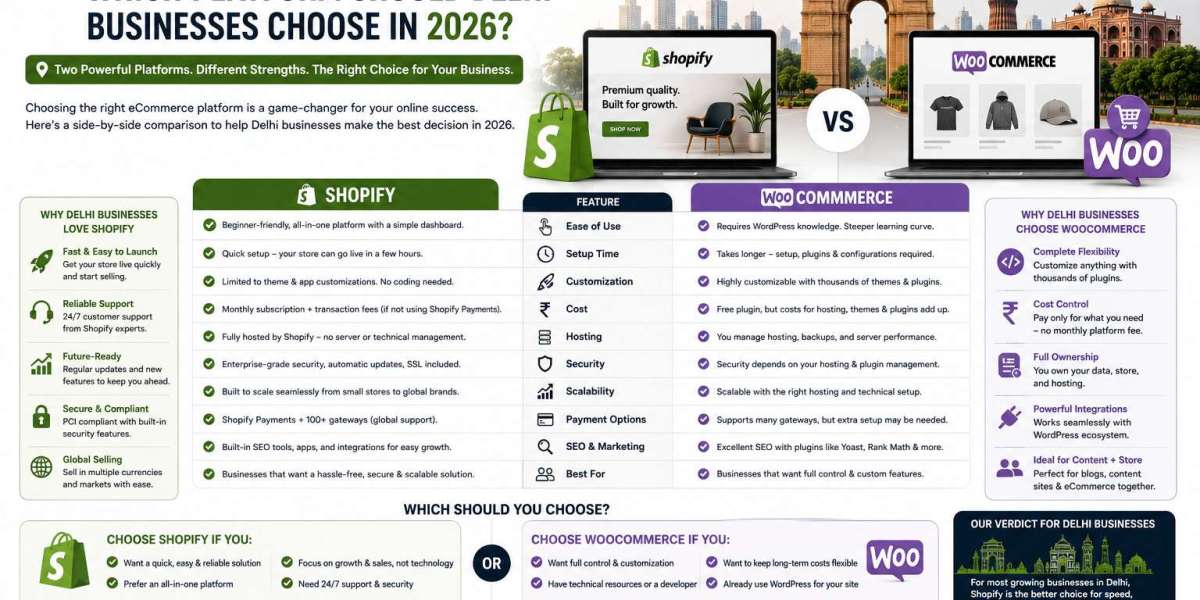

The Shopify-vs-WooCommerce debate resurfaces every year, and every year the honest answer is the same: it depends on what your business actually needs, not which platform has the louder fanbase online. Founders in Delhi's fast-growing D2C and retail-to-online segment ask this question constantly, and the wrong choice here is expensive to reverse once a catalog and customer base are already built on one system.
The Core Difference That Actually Matters
Shopify is a fully hosted platform — you rent the infrastructure, and Shopify manages hosting, security, and uptime. WooCommerce is a plugin on top of WordPress, meaning you own and manage the hosting environment yourself, or through a hosting provider.
This single distinction explains almost every other difference between the two platforms, from maintenance burden to total cost of ownership.
Shopify: Strengths and Trade-offs
Where Shopify Wins
Speed to launch, built-in security and PCI compliance, reliable uptime during high-traffic sales events, and a polished checkout experience that consistently converts well. For a founder without a technical team, this removes an enormous amount of operational risk.
Where Shopify Falls Short
Monthly subscription costs plus transaction fees (unless using Shopify Payments) add up over time, and deep customization beyond what apps allow requires developer intervention through Shopify's theme language.
WooCommerce: Strengths and Trade-offs
Where WooCommerce Wins
No mandatory monthly platform fee, full control over hosting and code, and near-limitless customization since it inherits WordPress's plugin ecosystem. Content-heavy brands that blend blogging with selling often prefer this flexibility.
Where WooCommerce Falls Short
You are responsible for hosting, security patches, and backups — or you need a Shopify development services agency in Delhi or WordPress specialist managing that for you continuously. Performance also depends heavily on hosting quality and plugin discipline; a poorly maintained WooCommerce store degrades fast.
A Practical Decision Framework
• Choose Shopify if you want to launch fast, have no in-house technical team, and prioritize reliability during sale events
• Choose WooCommerce if you already run WordPress content, need deep custom functionality, or want to avoid recurring platform fees at scale
• Choose Shopify if your growth plan includes multi-channel selling (Instagram, marketplaces) with minimal setup friction
• Choose WooCommerce if you have (or plan to hire) dedicated technical staff to manage hosting and security
Cost Comparison for a Typical Delhi D2C Brand
For a mid-sized catalog (100-500 SKUs), Shopify's all-in cost including plan, apps, and payment processing typically lands between ₹8,000-₹25,000 per month depending on app usage. WooCommerce can be cheaper on paper — often ₹3,000-₹10,000 per month in hosting and plugin licenses — but only if you are not paying separately for the developer time needed to keep it stable, which many businesses underestimate at the outset.
Expert Tips
• If you are unsure, prototype on Shopify first. Its faster setup lets you validate demand before investing in a more customizable but higher-maintenance WooCommerce build.
• Whichever platform you choose, budget separately for SEO and content — platform choice affects technical SEO capability, but it does not replace an actual SEO strategy.
Frequently Asked Questions
Is Shopify better than WooCommerce for beginners?
Generally yes. Shopify's hosted model removes hosting, security, and server management from your plate, which matters most for founders without technical staff.
Is WooCommerce cheaper than Shopify long-term?
It can be, but only if hosting and security are managed well. Poorly maintained WooCommerce stores often cost more in emergency fixes than Shopify's subscription would have.
Can I migrate from WooCommerce to Shopify later?
Yes, migration tools and agencies handle this regularly, though product data, SEO redirects, and customer records need careful handling to avoid ranking or data loss.
Which platform is better for SEO?
Both can rank well when set up correctly. WooCommerce offers more granular technical control since it runs on WordPress; Shopify offers a cleaner, faster baseline out of the box.
Does Shopify work well for businesses selling on Instagram and marketplaces too?
Yes, Shopify's native integrations with Meta, Google, and major marketplaces make multi-channel selling significantly easier to set up than WooCommerce's plugin-based equivalents.
Conclusion
There is no universally "better" platform — only a better fit for your specific stage, technical resources, and growth plan. What matters more than the platform choice itself is who builds and maintains it.
MarketingBugs works across both Shopify and WooCommerce builds for Delhi businesses, and our first conversation with any new client is always about which platform actually fits their operations — not which one we prefer to sell.
This comparison skips the generic feature lists you have already seen and focuses on what actually matters for a Delhi-based business deciding between the two in 2026 — and it is a question we get asked in nearly every discovery call at MarketingBugs, which as the best digital marketing agency in Delhi for e-commerce builds, means we have watched both platforms play out across dozens of real launches.