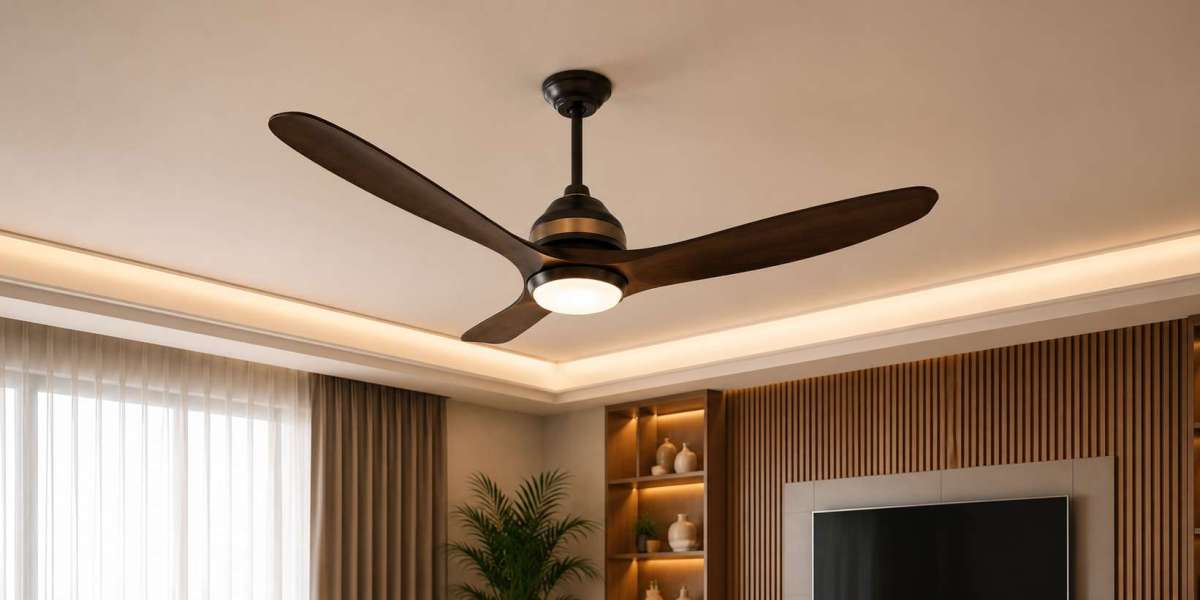

A procurement manager in Surat once told me his warehouse ceiling fans burned through the same wattage as a small refrigerator, running eight hours a day, every day. Nobody had questioned the spec sheet since 2016. That's the trap most wholesalers fall into — reordering the same induction-motor fan year after year because it's familiar, not because it's efficient. A BLDC Ceiling Fan flips that math. Instead of an AC induction motor drawing 70-80 watts, a Brushless DC motor does the same air delivery job on roughly a third of the power.
For bulk buyers stocking hundreds or thousands of units, that difference shows up on every single electricity bill your end customer pays — and eventually, on your repeat order volume. This isn't a marketing angle.
It's a motor design difference, and it changes how you should be evaluating BLDC Ceiling Fans for your catalog.
The Spec Detail Most Buyers Skip
Everyone compares sweep size and RPM. Fewer people compare starting torque under low voltage, which is where BLDC technology actually separates itself.
Motor and Power Draw
Traditional induction motors rely on copper windings that generate heat as a byproduct of running — heat is wasted energy. A BLDC Ceiling Fan uses electronic commutation instead of mechanical brushes, which means less friction, less heat loss, and power consumption that typically lands between 28-32 watts on a 1200mm sweep, against 75+ watts for a comparable AC fan.
Airflow and Blade Balance
Air delivery (measured in CMM — cubic metres per minute) matters more than RPM alone. A fan spinning fast with poorly balanced blades still delivers uneven airflow and vibrates the mounting bracket loose over time. Precision blade balancing is a manufacturing step, not a design footnote, and it's the one most price-driven suppliers cut first.
The Overlooked Spec
Voltage tolerance. Most catalog sheets list a fan's rated voltage and stop there. What they don't list is how the fan performs during a brownout — a real and frequent condition across large parts of the Indian grid. BLDC fans with proper IC-driven control boards hold consistent speed through voltage fluctuation. Cheaper boards don't, and the fan just slows down or hums. Ask for this data before you commit to a purchase order, because it rarely appears unless you request it directly.
Five Checks Before You Sign the Purchase Order
Here are five things worth checking before you sign anything:
Certification currency — is the ISO certificate active, or expired and "in renewal"?
Sample-to-bulk consistency — does the bulk batch match the sample you approved, blade-for-blade?
Defect policy in writing — not a verbal promise.
Packaging standard — corner protection and carton strength for the actual transit route, not a generic box.
Lead time honesty — a real date, not "soon."
A supplier who says "we'll handle defects case by case" doesn't have a policy. That's a negotiation you'll lose after the shipment lands, when you have no leverage left and a warehouse full of stock you can't return. And when a supplier can't produce a current certificate on request — not a scanned copy from three years ago — that's not a paperwork gap. That's a signal, and it's exactly the kind of gap that separates serious BLDC Ceiling Fan Suppliers from people reselling someone else's stock under their own label.
Why Location Is a Supply Chain Decision, Not Just an Address
We manufacture out of J K Industrial Park in Taravada, Rajkot — a district that's built an entire cluster economy around fan and electrical component manufacturing, and one that's become a genuine concentration point for BLDC Ceiling Fan Manufacturers rather than a scattered handful of workshops. That matters for procurement math beyond just proximity: raw material sourcing (copper wire, motor components) happens locally, which shortens the chain between input and finished unit and reduces the freight layering that inflates cost on fans sourced from more fragmented supply regions. For dealers and wholesalers across Gujarat, Rajasthan, and Haryana, that regional density also means better container consolidation options out of Mundra and Pipavav.
Send Us Your Spec Sheet
MOQs vary by model and finish, so we'd rather quote you an accurate number than a flat one that doesn't hold up once you add remote-control variants or custom blade colors into the mix. Send us your target sweep size, blade finish, and expected order volume, and we'll come back with a same-week confirmation on pricing and lead time — not a vague "we'll get back to you." If you're comparing us against other BLDC Ceiling Fan Suppliers in India, ask for our current ISO certificate directly; we'll send it without the back-and-forth.
The Bottom Line
A BLDC Ceiling Fan isn't just a lower electricity bill on a spec sheet — it's a motor architecture that changes failure rates, noise complaints, and voltage resilience across an entire installed base. For wholesalers and procurement teams stocking at volume, that difference compounds across every unit sold. The suppliers who can back that up with current certification and a real defect policy are worth building a relationship with. The ones who can't are a liability you'll discover after the container clears customs.
FAQs
1. What's the difference between a BLDC Ceiling Fan and a regular ceiling fan?
A BLDC fan uses a brushless DC motor with electronic commutation instead of an AC induction motor with mechanical brushes. That means lower power draw — usually 28-32 watts against 75+ watts — less heat generated, and typically longer motor life since there's no brush wear.
2. Do BLDC Ceiling Fans work with a standard AC power supply?
Yes. The fan has a built-in rectifier that converts AC input to DC for the motor. You don't need special home or facility wiring to run one.
3. Are BLDC ceiling fans worth it for bulk retail stocking, or is the price premium too high?
It depends on your customer base. The unit cost is higher than a basic AC fan, but the running-cost savings usually pay that gap back within 12-16 months for the end user. If your retail segment is price-sensitive and doesn't hold onto appliances long-term, that math matters less to them than it does to a commercial buyer.
4. Who are reliable BLDC Ceiling Fan Manufacturers in India?
Look for BLDC Ceiling Fan Manufacturers who can show current ISO certification, a documented defect policy, and consistency between sample units and bulk batches. We manufacture from Rajkot, Gujarat, and we're happy to have our certification checked before you place an order — that verification step should be standard practice with any BLDC Ceiling Fan Manufacturers in India you're evaluating, not an exception.
5. What should I ask BLDC Ceiling Fan Suppliers before placing a bulk order?
Ask for defect policy in writing, current certification, packaging specification for your transit route, and a real lead-time date. Reliable BLDC Ceiling Fan Suppliers in India won't hesitate on any of those four points — if a supplier does, that's worth noting before you commit.












