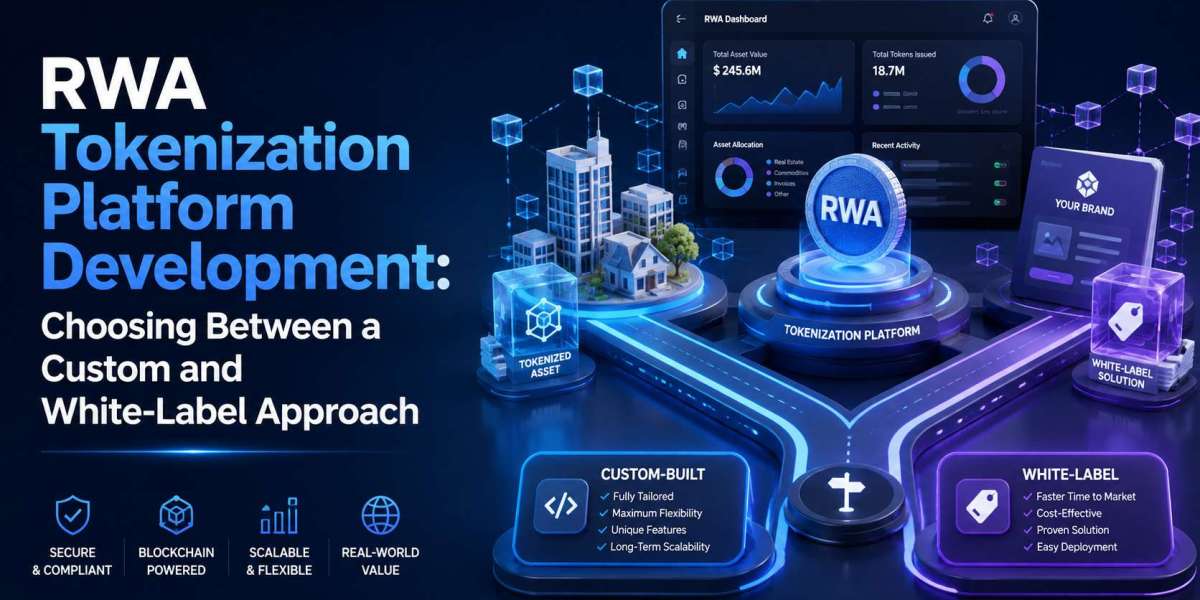

Real-world assets are moving into blockchain-based markets as businesses look for new ways to represent ownership, investment rights, and asset-related claims digitally. Real estate, private credit, commodities, art, infrastructure, and other asset classes can be represented through token-based models when the legal and technical structure supports it. This has increased demand for RWA Tokenization platforms among asset managers, financial firms, investment businesses, and Web3 companies.
When planning rwa tokenization platform development, one of the first decisions is whether to create a platform from the ground up or start with a white-label solution. Both approaches can support token issuance, investor onboarding, asset management, compliance workflows, wallet connections, and secondary trading functions. However, they differ significantly in development time, control, cost, maintenance, and technical responsibility.
A custom platform gives the business greater control over how the system operates. A white-label platform provides a ready-made foundation that can be branded and configured for a specific business model. The right choice depends on the asset classes, target investors, regulatory requirements, operating model, budget, and long-term product plans.
What Is a Custom RWA Tokenization Platform?
A custom RWA tokenization platform is developed specifically around the requirements of a business. Instead of starting with a pre-existing product, the development team creates the platform architecture, user interfaces, smart contracts, APIs, admin systems, compliance modules, and other components according to the planned use case.
For example, a company dealing with commercial real estate may require property onboarding, ownership documentation, investor verification, rental income distribution, token issuance, transfer restrictions, and reporting features. These requirements can be incorporated into the platform during development.
A custom approach is generally considered when the business has a distinct operating model or requires functionality that is not commonly available in packaged solutions. It can also be suitable for companies planning to operate the platform as a long-term technology product rather than simply using it as an internal system.
How Does Custom RWA Tokenization Platform Development Work?
The process usually starts with business and technical planning. The team identifies the asset categories, token structure, investor types, jurisdictions, compliance requirements, blockchain network, custody model, and transaction processes.
The next stage involves designing the platform architecture. This can include the frontend application, backend services, smart contracts, database systems, wallet integration, identity verification, compliance checks, payment processing, asset records, and administrative controls.
Smart contracts then define how tokens are issued, transferred, restricted, redeemed, or distributed. Depending on the asset type, the contracts may contain functions related to ownership records, investor eligibility, transfer rules, income distribution, and token supply.
Testing follows development. Smart contract testing, API testing, user-flow testing, security reviews, and compliance workflow checks can be performed before the platform reaches production.
This approach gives a business substantial control over the product, but it requires more planning, development work, testing, and ongoing technical maintenance.
What Is a White-Label RWA Tokenization Platform?
A white-label platform is a pre-developed tokenization solution that can be configured for use under a company's own brand. Instead of starting every component from the beginning, the business uses an existing platform foundation and adjusts elements such as branding, supported assets, investor workflows, token settings, compliance procedures, and user interfaces.
For businesses that want to enter the tokenization market within a shorter development cycle, this approach can be practical. A white-label solution may already contain modules for investor registration, token issuance, wallet connectivity, asset management, dashboards, administrative functions, and transaction processing.
A business can work with an RWA Tokenization Company that provides the platform and related technical support. Depending on the provider, the package may also include RWA Tokenization Services covering smart contract deployment, blockchain integration, compliance components, platform configuration, and maintenance.
How Does White-Label RWA Tokenization Work?
The process generally begins with selecting a suitable platform provider. The business reviews the available functions, supported blockchain networks, asset categories, compliance features, wallet options, and administrative controls.
After selecting the platform, branding and configuration are handled. This may include the company's logo, colors, domain, investor dashboard, asset categories, token parameters, user roles, and business-specific workflows.
The provider then configures the required modules and integrates external services such as identity verification, payment gateways, custody systems, blockchain networks, and analytics tools.
Testing is performed before launch. The business can review investor onboarding, token issuance, wallet transactions, asset information, and administrative functions. Once the platform passes the required checks, it can be released for users.
This method reduces the amount of software that needs to be developed from the beginning, although the final level of customization depends on the white-label provider.
Custom vs White-Label: Development Time
Development time is one of the biggest differences between the two approaches.
Custom RWA tokenization platform development normally takes longer because the architecture, smart contracts, interfaces, backend functions, integrations, and security processes are developed around the company's requirements. The timeline also depends on the number of asset classes and external services involved.
White-label development can have a shorter timeline because many platform components already exist. The work focuses more on configuration, branding, integrations, testing, and business-specific adjustments.
For companies that want to validate a tokenization business model without spending a long period on software creation, white-label development may provide a practical starting point.
Custom vs White-Label: Cost Considerations
The cost structure also differs.
Custom development requires spending on product planning, UI development, backend engineering, blockchain development, smart contracts, integrations, testing, security reviews, infrastructure, and maintenance. The initial investment can therefore be considerable.
White-label development usually reduces the amount of initial software development required. However, the business may pay licensing fees, setup charges, transaction fees, maintenance costs, or subscription expenses depending on the provider.
A company should not compare only the initial development price. It should also consider long-term operating expenses, provider fees, maintenance requirements, feature additions, and infrastructure costs.
Custom vs White-Label: Flexibility
Custom platforms generally offer greater flexibility because the software is created around the business requirements. A company can decide how asset onboarding works, how tokens behave, how investors interact with assets, and how administrative workflows are organized.
White-label platforms provide flexibility within the limits of the existing product. Some providers offer extensive configuration, while others allow only branding and basic feature adjustments.
If a company has unusual token structures or specialized investor workflows, custom development may be more suitable. If its requirements match standard tokenization activities, a white-label solution may be sufficient.
Custom vs White-Label: Security and Compliance
Security should receive attention regardless of the development method.
A custom platform allows the business to define its security architecture from the beginning. Access control, wallet management, encryption, smart contract permissions, audit logging, and administrative security can be planned around the platform's requirements.
With a white-label platform, security depends partly on the provider's architecture, development practices, infrastructure, and update process. The business should review how the provider handles smart contract security, data protection, access control, monitoring, and incident response.
Compliance also needs to be considered before development begins. Tokenized assets can involve securities laws, investor eligibility rules, KYC procedures, AML checks, tax requirements, custody arrangements, and restrictions on token transfers. Technology alone does not determine whether a tokenization model is legally suitable.
Which Approach Is Better for Startups?
Startups often need to balance budget, market timing, product requirements, and future plans. A white-label platform can be useful when the startup wants to launch an initial tokenization service without spending heavily on a complete software product.
For example, a startup could use a white-label platform to offer tokenization for selected real estate or private-market assets. After gaining users and understanding market requirements, it could gradually introduce additional functionality.
However, startups planning to create a technology product with a highly differentiated business model may prefer custom RWA Tokenizaion development from the beginning.
Which Approach Is Better for Enterprises?
Large financial institutions, investment firms, asset managers, and established businesses may have more complex requirements. They may require specific integrations, permission systems, reporting structures, custody arrangements, compliance workflows, and internal data connections.
A custom platform can provide greater control in such situations. At the same time, enterprises can consider a white-label solution when they want to launch a new tokenization initiative while using an existing technical foundation.
The decision should be based on operational requirements rather than company size alone.
When Should You Choose Custom Development?
Custom development may be suitable when the business:
Has specialized tokenization requirements
Needs extensive control over platform architecture
Plans to develop proprietary token models
Requires multiple enterprise integrations
Wants complete control over future product changes
Plans to operate a large tokenization marketplace
Requires specific investor and compliance workflows
A business working with an RWA tokenization development company can define these requirements before development begins and select the blockchain architecture and technology stack accordingly.
When Should You Choose White-Label Development?
White-label development may be suitable when the business:
Wants a faster route to market
Has standard tokenization requirements
Wants to reduce initial software development work
Needs a branded platform
Wants to test market demand
Does not have a large in-house blockchain team
Plans to launch selected tokenized asset products first
An experienced provider offering RWA tokenization development services can configure the platform based on the selected asset class, investor model, token structure, and operational requirements.
What Should You Check Before Selecting a Provider?
Businesses should review the provider's technical capabilities before making a decision. This includes supported blockchain networks, smart contract standards, wallet integrations, identity verification, compliance modules, asset management functions, token issuance tools, investor dashboards, and administrative controls.
Security practices also deserve detailed attention. Ask about smart contract audits, penetration testing, access management, infrastructure security, monitoring, backup procedures, and update policies.
The provider's experience with Real World Asset Tokenization Services is also important. Tokenizing an asset involves more than issuing a blockchain token. Legal documentation, asset verification, investor rights, custody, compliance, and transaction rules all need to work together.
Custom and White-Label Can Work Together
The choice does not always have to be limited to one method.
A company can begin with a white-label platform and later introduce custom modules as its requirements increase. Another option is to use an existing platform foundation while developing specific components separately.
For example, the token issuance and investor management modules may come from a white-label platform, while a custom asset management system and internal reporting layer are developed separately.
This hybrid method can help businesses balance development requirements with available resources.
Final Thoughts
Choosing between custom and white-label RWA tokenization platform development depends on the business model, budget, asset types, investor requirements, compliance needs, and future product plans. Custom development provides greater control over the software and can suit businesses with specialized requirements, while white-label platforms can reduce development work for companies seeking a quicker market entry. Both approaches can support RWA Tokenization when the underlying legal, technical, and operational structure is properly planned. A business should evaluate the platform architecture, smart contracts, security practices, compliance workflows, integrations, maintenance model, and long-term costs before selecting an approach. Whether the goal is to launch an investment platform, tokenize real estate, issue private-market assets, or create a broader digital asset marketplace, the development method should match the intended business model. Blockchain App Factory provides RWA tokenization development services covering platform development, smart contract creation, blockchain integration, token issuance, and related technical requirements.
FAQs
1. What is RWA tokenization platform development?
RWA tokenization platform development involves creating software that represents real-world assets through blockchain-based tokens. The platform can include asset onboarding, token issuance, investor management, compliance workflows, wallet integration, and transaction functions.
2. Is custom RWA tokenization better than white-label development?
Neither approach is automatically better. Custom development may suit businesses with specialized requirements, while white-label development can suit businesses seeking a faster launch with an existing platform foundation.
3. How much does RWA tokenization platform development cost?
The cost depends on the platform features, blockchain network, smart contract complexity, integrations, security requirements, compliance functions, and development method. Custom platforms generally require more initial development work than white-label solutions.
4. What assets can be tokenized?
Depending on the legal structure and jurisdiction, businesses may tokenize real estate, private credit, commodities, art, infrastructure, funds, and other asset categories.
5. What does an RWA Tokenization Company provide?
An RWA Tokenization Company may provide tokenization consulting, smart contract development, platform development, blockchain integration, investor management functions, compliance integrations, testing, and maintenance.
6. What are RWA Tokenization Services?
RWA Tokenization Services can cover the technical and operational components involved in representing real-world assets through blockchain tokens. The exact services vary between providers.
7. Can a white-label platform be modified later?
Yes, depending on the provider. Some platforms allow additional modules, integrations, interface changes, and business-specific functions to be added later.
8. What is RWA token development?
RWA token development refers to creating blockchain tokens that represent rights or interests connected to real-world assets. Token rules depend on the asset structure, investor model, legal framework, and selected blockchain.
9. Why is smart contract security important?
Smart contracts can control token issuance, transfers, permissions, and other asset-related functions. Security testing and auditing can help identify coding issues before contracts are used in live transactions.
10. How do I choose an RWA tokenization development company?
Review its blockchain experience, smart contract capabilities, security practices, platform features, integration experience, development process, maintenance support, and previous work involving Real World Asset Tokenization Services.