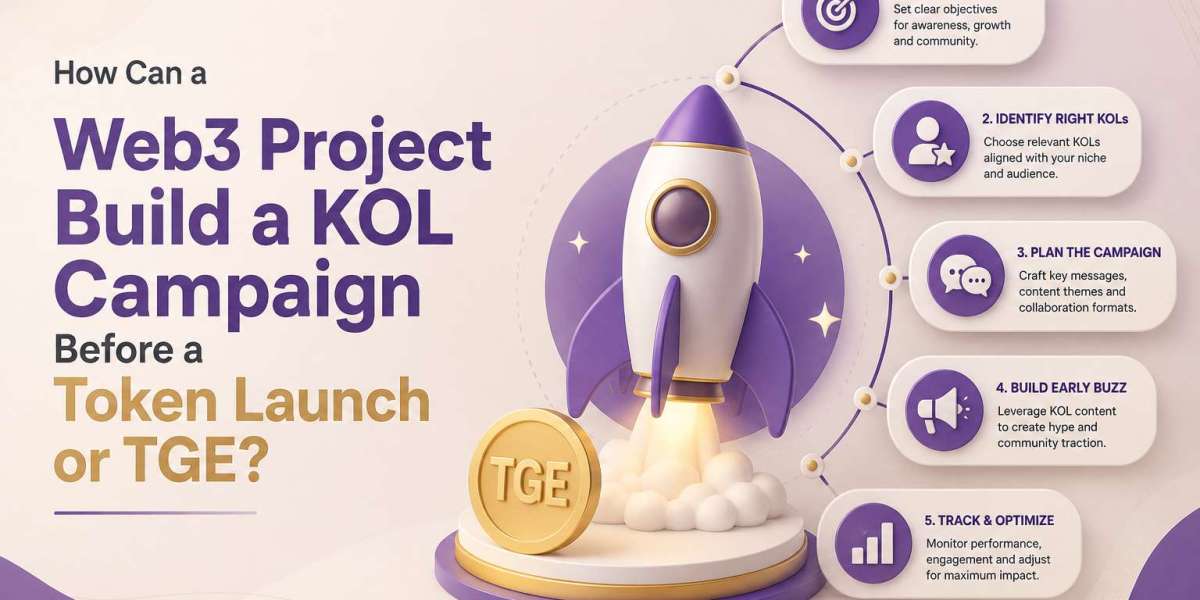

A token launch or Token Generation Event (TGE) can create a huge amount of attention in a short period.
But that attention should not start on launch day.
By the time a token goes live, successful Web3 projects have usually spent weeks or months building awareness, educating their audience, developing community interest, and establishing relationships with relevant creators.
This is where crypto KOL marketing becomes especially useful.
A well-planned pre-TGE KOL campaign can help a project introduce its narrative early, build credibility, reach targeted communities, and create a base of interested users before the token becomes available.
The key is not to simply pay influencers to post about the upcoming token.
The goal is to build progressive awareness before the launch.
What Is a Pre-TGE KOL Campaign?
A pre-TGE KOL campaign is an influencer marketing strategy that starts before a project's token generation event.
Instead of waiting until launch day, the project works with selected crypto creators across multiple stages.
For example:
Stage 1: Introduce the project
Stage 2: Educate the audience
Stage 3: Build community interest
Stage 4: Increase anticipation
Stage 5: Communicate the launch
Stage 6: Support post-TGE activity
This creates a narrative rather than a collection of disconnected promotional posts.
Why Start KOL Marketing Before TGE?
Launching a token without an established audience can make it difficult to generate meaningful attention.
A pre-TGE campaign gives the project time to:
- Build awareness
- Test different narratives
- Identify relevant audiences
- Develop KOL relationships
- Grow social channels
- Build community
- Educate potential users
- Generate early interest
- Collect campaign data
It also gives the marketing team an opportunity to discover which creators and content formats actually work before the most important stage of the launch.
1. Define the Campaign Goal First
Don't start by making a list of influencers.
Start by defining what the campaign needs to accomplish.
A pre-TGE campaign could focus on:
Awareness
Make more people aware of the project.
Education
Explain the technology and problem the project is solving.
Community Growth
Increase Telegram, Discord or X followers.
Whitelist or Early Access
Drive qualified users toward an early-access opportunity.
Testnet Participation
Bring more users into the product before TGE.
Launch Awareness
Build anticipation around the upcoming token event.
A campaign can have multiple goals, but there should always be a primary objective.
2. Build the Project Narrative
Before contacting KOLs, determine what the project wants people to remember.
A project may have dozens of features, but KOL campaigns work better when creators can communicate a simple narrative.
For example:
"This project is building decentralized infrastructure for AI developers."
That is easier to understand than listing ten technical features.
The narrative can then be supported with additional talking points.
Core Narrative
What is the project?
Problem
What problem does it solve?
Differentiator
Why is it different?
Product
What can users actually do?
Future
Where is the ecosystem heading?
TGE
Why does the upcoming token matter?
This gives creators a foundation without forcing them to use identical messaging.
3. Segment KOLs Instead of Treating Everyone the Same
Not every KOL should receive the same campaign role.
A useful pre-TGE campaign can include several creator categories.
Tier 1: Large KOLs
Useful for broader awareness.
Tier 2: Mid-Sized KOLs
Useful for targeted reach and stronger community interaction.
Tier 3: Micro-KOLs
Useful for niche audiences and potentially stronger engagement.
Technical Creators
Useful for explaining complex products.
Analysts
Useful for research-based content.
Traders
Useful when the product has a strong trading or market angle.
Community Creators
Useful for discussions, spaces and community activation.
The strongest campaigns often combine several of these groups.
4. Start With Education, Not Promotion
One of the biggest mistakes in pre-TGE marketing is starting with:
"Our token is launching soon. Buy it."
There may not even be a token available yet.
Instead, begin with education.
KOLs can discuss:
- The problem the project is solving
- The technology
- The market opportunity
- Product features
- Testnet activity
- Ecosystem developments
- Partnerships
- Community milestones
This helps the audience understand the project before the token becomes the primary topic.
5. Create a Content Sequence
A pre-TGE campaign should feel like a story.
For example:
Week 1 - Discovery
Creators introduce the project.
Goal: Awareness
Week 2 - Education
Creators explain the technology or product.
Goal: Understanding
Week 3 - Product
Creators explore the testnet or product.
Goal: Product interest
Week 4 - Community
Creators discuss the ecosystem and community.
Goal: Participation
Week 5 - TGE Countdown
Creators begin discussing the upcoming launch.
Goal: Anticipation
Launch Week
Creators communicate the TGE and relevant actions.
Goal: Activation
This is much stronger than asking 30 KOLs to publish the same announcement on the same day.
6. Give KOLs Different Angles
Your campaign should have consistent messaging, but the content shouldn't look identical.
For example, one creator could discuss:
"Why decentralized AI infrastructure is becoming important."
Another could focus on:
"What this project is building."
Another could explain:
"How the testnet works."
Another could analyze:
"What to watch before the project's TGE."
Another could create a short educational thread.
The project narrative stays consistent while the content remains diverse.
7. Use Micro-KOLs Early
Micro-KOLs can be particularly useful during the early stages of a campaign.
They often have smaller but more focused communities.
For example, instead of spending the entire budget on one large creator, a project could test:
- 5 DeFi creators
- 5 crypto analysts
- 5 technical creators
- 5 regional creators
The campaign can then identify which segments generate the strongest engagement and conversions.
Those insights can guide the larger campaign closer to TGE.
8. Build a KOL Relationship Before the Main Campaign
Don't treat every KOL relationship as a one-time transaction.
If a creator understands the project early, they can potentially create better content later.
Start by introducing the project.
Then provide:
- Product access
- Documentation
- Founder interviews
- Technical resources
- Community access
- Testnet access
- Updates
The creator becomes more familiar with the project.
That familiarity can make later content much more authentic.
9. Give KOLs Early Product Access
Whenever possible, allow selected creators to experience the product before the main campaign.
For a Web3 project, this could mean:
- Testnet access
- Demo access
- Beta product
- Developer environment
- Community calls
- Product walkthroughs
First-hand experience gives creators something much more valuable than a marketing document.
They can talk about what they actually experienced.
That can lead to stronger content and more credible discussions.
10. Track Every KOL Separately
Don't measure the campaign as one giant number.
Give every KOL a unique tracking setup.
Track:
- Views
- Engagement
- Link clicks
- CTR
- Registrations
- Community joins
- Testnet users
- Whitelist applications
- Conversions
Use unique URLs or tracking parameters whenever possible.
For example:
project.com/testnet?ref=kol01
This allows the team to determine which creators are actually driving results.
11. Measure More Than Impressions
Impressions can look impressive in a campaign report, but they don't necessarily mean the campaign worked.
Suppose:
KOL A: 500K impressions → 20 registrations
KOL B: 100K impressions → 150 registrations
KOL A generated more visibility.
KOL B generated more users.
Depending on the campaign objective, KOL B may be much more valuable.
Useful metrics include:
| Metric | Purpose |
|---|---|
| Impressions | Measure awareness |
| Views | Measure content reach |
| Engagement rate | Measure interaction |
| Clicks | Measure interest |
| CTR | Measure traffic efficiency |
| Registrations | Measure acquisition |
| Community joins | Measure community growth |
| Testnet users | Measure product interest |
| Conversion rate | Measure campaign effectiveness |
| CPA | Measure acquisition cost |
12. Create a TGE Countdown
As the launch approaches, gradually increase communication.
For example:
30 days before TGE:
Focus on education.
21 days before TGE:
Highlight product progress.
14 days before TGE:
Increase community and ecosystem content.
7 days before TGE:
Begin stronger launch communication.
3 days before TGE:
Provide important launch information.
TGE day:
Focus on accurate, timely communication.
The exact schedule depends on the project, but the principle remains the same:
Build anticipation progressively instead of creating all the noise at once.
13. Keep Token Messaging Responsible
Token marketing requires particular care.
Avoid asking KOLs to make:
- Guaranteed return claims
- Price predictions presented as facts
- "100x" promises
- Fake scarcity claims
- Misleading partnership statements
- Unverified exchange announcements
Instead, focus on factual information.
For example:
- What the token is used for
- Token utility
- Ecosystem participation
- Official launch information
- Distribution details
- Governance functionality, where applicable
The objective should be to create informed interest rather than artificial hype.
14. Prepare a Crisis and Misinformation Plan
TGE campaigns move quickly.
A single incorrect post can spread rapidly.
Before launch, establish:
- Who approves factual corrections?
- Who communicates with KOLs?
- Where can creators verify information?
- Who handles unexpected announcements?
- What happens if incorrect information goes viral?
Create a central information source that KOLs can reference.
This makes it easier to correct information quickly.
15. Keep the Community Involved
KOL marketing shouldn't operate separately from community marketing.
If a creator discusses the project, the audience should have somewhere to continue the conversation.
That could be:
- Discord
- Telegram
- X
- Governance forum
- Community calls
The journey should look something like:
KOL content → Website → Community → Product → Retention
If the KOL generates attention but there is no strong destination, much of that attention can disappear.
A Simple Pre-TGE KOL Campaign Framework
A Web3 project can structure its campaign around five stages:
Phase 1 — Foundation
- Define narrative
- Identify target audience
- Research KOLs
- Prepare campaign materials
Phase 2 — Awareness
- Introduce the project
- Publish educational content
- Start community conversations
Phase 3 — Product
- Give selected KOLs product access
- Encourage reviews and walkthroughs
- Highlight milestones
Phase 4 — TGE Build-Up
- Increase creator activity
- Start countdown content
- Explain token utility
- Share official launch information
Phase 5 — TGE & Post-TGE
- Coordinate launch communication
- Track conversions
- Continue creator content
- Retarget engaged audiences
- Measure long-term user activity
Common Pre-TGE KOL Mistakes
Choosing KOLs Based Only on Followers
Large audiences don't guarantee relevant users.
Starting Too Late
Waiting until launch week limits your ability to build familiarity.
Giving Every KOL the Same Script
This makes the campaign feel repetitive and promotional.
Focusing Only on Impressions
Reach is useful, but conversions matter too.
Ignoring Micro-KOLs
Smaller creators can provide highly relevant audiences.
Overhyping the Token
Aggressive promises can damage credibility.
Forgetting Post-TGE Marketing
The campaign shouldn't end when the token launches.
Final Thoughts
A successful pre-TGE KOL campaign is not about getting as many influencers as possible to mention a token.
It is about building familiarity before the launch.
Start with education. Introduce the product. Let creators experience it. Build community interest. Test different audiences. Measure what works. Then gradually increase the focus on TGE.
By the time launch day arrives, the audience should already understand what the project is, why it matters, and where they can participate.
That's the real value of starting KOL marketing early.
A strong pre-TGE campaign doesn't simply create launch-day noise.
It builds the audience that the project can continue engaging after the TGE is over.